|
This Pillar Stone just to the north-west on the Slieve Gullion Ring Dyke is a menhir, - a tall, upright stone that once formed a tiny part of the Annaghcloughmullion cairn, an edifice in its time worthy of those at New Grange in the Boyne Valley.
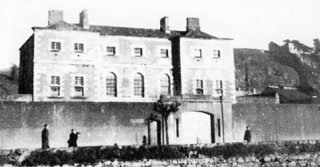
That we know anything at all about it now is due to its having been recorded in the ancient literature, in the publication ‘Etruria Celtica’, complete with a sketch, plans and drawings of pottery unearthed there. Thomas Synnott opened it in 1791. He found that the entrance pillars were giant stones some thirteen feet in height and that the internal chamber, which was divided into four sections, was some nineteen yards long. The dolmen roof of this chamber was supported by massive nine feet high menhirs. In the various compartments he discovered ancient clay vessels which would normally have contained human remains but here were empty. It is reported that Lord Gosford used up to one hundred tons of its stone to build his now deserted castle outside Markethill. Why? Because he could! And these then were transported over a considerable distance of poor nineteenth century roads. Today his plunder forms an ugly edifice (Photo above) in the picturesque Gosford Forest Park. At Annaghcloughmullion the beautiful Neolithic structure is no more.
This of course was not an isolated case. Nor was the plunderer always the Planter or the Saxon. It is believed that the Clontygora Court Cairn, and many others, were ruthlessly raided over the centuries for building stones. There are still on the latter monument, rusting steel pins where the thief tried and failed to remove and transport the last of the great menhirs from there. Much of its stone went to build the canal, and the Ship Canal below. And oral tradition has it that what remained after Gosford’s remarkable act of vandalism at Annaghcloughmullion was later taken in the construction of the first Lislea Church. Surely a tragic irony if true, since our ancient forefathers also had a religious motivation in their first great feat of engineering. One has to reflect what might have been the fate of the great monuments at Howth and Dowth, had they earlier come to the light of modern man. And indeed, what act of vandalism will be perpetrated when the Dublin Government drives the M3 through the Hill of Tara! |