Down, Down, Armagh

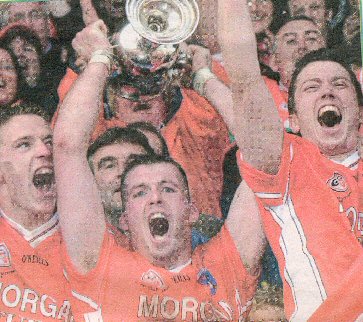
Under21AllIreland.jpg
When Armagh won the All-Ireland two years ago, in the midst of my delight I shed a silent tear for Cardinal Tom and his own ‘team’ mate, my Uncle Jamesy, who would have given anything to witness such an event during their lives.
 
Would this side go on to become one of the ‘great’ Gaelic teams?  It was while awaiting an answer to that beguiling question that I delayed adding the team to this Characters list.  I waited until today to decide.  When Armagh took the Anglo-Celt Cup at Croke Park today, defeating Donegal with their best display of football yet – not excluding their 2002 victory – they earned that mantle.
 
There are a few games yet but now I am confident that Armagh will win its second crown before the summer is out and join the great Ulster teams of the recent past, the inimitable Down side of 1959-1968 being the first of living memory.  We all remember men like James McCartan, Dan McCartan, Joe Lennon and Paddy Doherty who not only won titles but changed the nature of the game in the process.
 
The successful Down team of 1991-1994 may not quite have reached the same dizzy heights but won two All-Ireland titles on the way.  Among this side’s great and well-remembered characters were James McCartan, Paddy O’Rourke, Greg Blaney and Ross Carr.  That Paddy and Ross are still highly involved in managing current Down sides speaks highly of their commitment.  
 
Today Joe Kernan gave a number of subs a run-out and they excelled.  There is strength in depth.  I am confident that Armagh will take Sam again in September and that future generations will remember the names of today’s Armagh team.  For the record then, today’s starting line-up was
 
P Hearty: F Bellew: A Mallon: K Hughes: K McGeeney: A O’Rourke: P Loughran: P McGrane: P McKeever: T McEntee: O McConville: S McDonnell: R Clarke: D Marsden
 
(If you don’t know what Christian name each initial stands for, you’d better learn!  Everyone else does!!)

Beer Taster Wanted

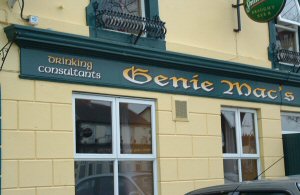
drinkingconsultants.jpg
‘You’ve seen those small ads in the papers that always end with the words ‘No time-wasters, please’.  
 
Many’s the time I’d have applied but I always had to admit to myself that, indeed, I was nothing but a time-waster.  In truth, it’s my preferred way of using time – just whiling it away – wasting it, according to some!


I debated with myself again as I answered the advertisement to fill Piztasha Newt’s recently vacated position with Brahma Breweries.  
 
True, the job was seven thousand miles away in Brazil:  I was not a citizen, naturalised or otherwise:  I had no visa or passport:  I had no contacts in the country:  I had never before been employed as a beer-taster.  
 
But in every other way, I was eminently suited to the position.  Nor would I ever in the future contemplate – as Pistasha had done – taking my employers to court for failure to warn me of the addictive dangers of the job.
 
Brahma Breweries expected to win the court case, presumably the main reason they delayed re-advertising the position until after the verdict.  Unfortunately they lost and when the terms of the settlement became clear, there were 354,472 applicants for Newt’s old job.
 
Newt testified to the court at Rio de Janeiro,
 
‘Every day I was expected to drink eight litres of beer to monitor its quality.  I left work blind drunk every evening.
 
Twenty years on and I am an incorrigible alcoholic.  I am unable to hold down alternative employment.  
 
I am seeking compensation and a pension for life.’
 
The verdict came as a body blow to the Brewery. 
 
‘Every employer has a duty to prevent his workers from ingesting harmful substances.  
 
He has given twenty years as a Master Brewer and Chief Taster.  He tells us that beer tasters – unlike wine tasters – have to swallow their drinks. The Tribunal therefore rules that he is entitled to $2m in compensation from the Brewery, a monthly pension for life of $2,600 and an unlimited supply of Brahma beer free.’


Now, that’s just silly!  I’d settle for a lot less than that!  
 
Would ye put in a word for me, if ye know anybody on the Brewery’s Board of Directors?

Ye cleared it well, Dan!

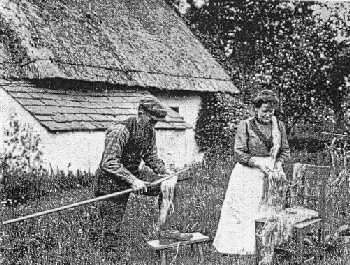
FlaxWorking.jpg
‘I don’t mind the fairies [remember] but I do mind Dan Malloy who lived in the house next till the one where the ghost is.  He had a sweetheart an’ that wus near till a century ago.  An’ till see her he be till cross the river near till the gentry bushes.
 
An’ many a time he toul’ it hiself, says he, ‘At night I wud be takin’ the short cut till save me legs.  An’ the aisyest place till be crossin’ wud be be the thorns.  An’ as shure as yer there, six nights out of seven, a voice wud say, ‘Dan, ye cleared it well that time’.  An’ I wud say, ‘Och, aye,’ an’ go me way.  An’ I always respected the thorns for it’s mortal unlucky till annoy them.
 
Mebbe your cattle wud bog in a drain or worse.  Many a good man went till the bad because of takin’ liberties with them kind of bushes.
 
Many a time I heard the story’.

Burial Customs

magennis.jpg

 ‘On the day of a funeral, a large concourse of people assembles who are plied with spirits, generally two glasses.  The corpse is then placed on the bier which is covered with a pall.  It is then hoisted on men’s shoulders and they are followed by the keeners who intone alternatively all the way to the burial place.  The bearers are relieved frequently by others.

It often happens that if another funeral should appear from a different direction that a scene of competition commences for precedence.  Sometimes it turns into strife or riot.  In explanation of this custom we have heard it said that when graveyards were not hedged about, it was usual to post a sentinel at night to watch the graves from wild beasts and every other thing to which they might be exposed. (Editor: perhaps the sensibilities of his religious office caused Rev Nelson not to mention the greatest danger from grave-robbers).  This office fell to the relatives of those who had been last buried in the cemetery.’  [Nelson, 1840]

Trouble the Yanks Bring

millst60s.jpg
Those trained in music can read a score and ‘hear’ the symphony in the mind’s ear, much as the rest of us hear it in reality when it is played professionally. 
 
You could, I suppose, be trained to ‘hear’ the storyteller in a similar fashion from the printed page (or electronic page in our case!) but only if you have often heard the master storyteller in action.  All the usual reservations printed before apply to your reading of the following tale.
 
‘On the hip of Slieve Gullion mountain there lived two women, and I’ll tell you what they done for forty-five years. 
 
They conveyed one another to first Mass in Mullaghbane every Sunday morning. 
 
Walked and talked the whole way over: walked and talked the whole way back:  and talked all the way through mass as well.
 
Lizzie and Bridget was their names, and one Sunday morning they went over to mass and when they went over the Chapel was full up with young people. 
 
Armagh were away to be bet some place the same Sunday!
 
The very minute Mass was over there was a stampede for the door and Lizzie and Bridget were waylaid in the crowd – rent asunder – and when Bridget got out till the chapel gates, what the blazes do you think Lizzie was doing? 
 
She was standing there talking to two returned Yanks. 
 
Great big Yankee man about six fut four with a white hat on him, smoking a cigar the length of a poker, and a nice, nate little bit of a Yankee woman with short sleeves on her and a big, glossy handbag that ye cud put two bales of straw in if ye were badly stuck. 
But God bless the mark, two elbows like two corkscrews.
 
When Bridget got out to the gate she didn’t want to be standin’ looking at her…  at Lizzie, with her mouth open like a melodian.   She walked on. 
 
An’ in no time at all Lizzie overtook her on the road: an’ when Lizzie overtook her, Bridget turns round and says,  {whinging voice!}
 
”Who was the great swells ye were talking to at the chapel gates this morning?’  
 
{High-pitched answer!}
 
‘Ah well, ye’ll not believe it, she says, when I tell you. 
 
Home from America, and know our Michael’s Pat that went to New York, and they’re comin’ up to see me, she says, on Tuesday evening.’
 
‘Oh Lord, says Bridget, that’ll put ye to a dale of bother!’ 
 
As jealous as the devil.  
 
‘Bother, she says, what bother will it put me till?’
 
‘Oh, she says, ye’ll have till wheel out the bicycle in the morning, she says, get into town and buy a bottle of whisky for them, she says, and buy mate for them, she says, and buy cakes for them, for the devil in hell wouldn’t stuff them aul’ Yanks whenever they come home.  
 
The Lord have mercy on me mother and father had them home in 1933 and we didn’t get the better of them yit! 
 
{Aside: This was the year before last!}
 
‘They’ll put me to no bother whatsoever in this world, says Lizzie, for I’ll tell you what I have yonder at the house. 
 
I have a gander that was left on me hands at Christmas, she says, and I’ll go home now, she says, and I” catch him, she says, and I’ll neck him, she says, and I’ll pluck him, she says, and I’ll gut him, she says, and I’ll stuff him, she says, and I’ll roast him, she says, and I’ll have him for the Yanks whenever they come.’
 
 {At fast speed!}
 
An’ home she went, and she caught him, and she necked him, and she plucked him, and she gut him, and she stuffed him, and she roast him and she had him… 6, 7, 8, 9, 10 and eleven o’clock come on Tuesday evening, and no Yank appeared.
 
And the following Sunday morning she went over the road and she met Bridget and the first thing Bridget said to her was,
 
‘Well, she says, How did ye get on with the Yanks?’
 
‘Ah, says Lizzie, shure they never appeared!’
 
‘Och, says Bridget, and isn’t it an awful shame!  An’ the Christmas bird going bad on yer hands like that!’
 
‘Ah no! says Lizzie, the bird didn’t go bad on me hands.’
 
‘Oh well, she says, ye had to give him away?’
 
‘No, she says, I didn’t give him away.’
 
‘An’ what then in the name of God did ye do with him?’
 
‘I ate him, she says, meself.’
 
‘The whole gander?  Yerself??’
 
‘I did, she says, and not a bit of bother on me.’
 
‘Ah, the Lord save us, says Bridget, me heart will stop!  For a woman to do the likes of that!’
 
‘An’ what harum was it, says she, for me to ate what I reared up from a goose egg?’
 
‘Harum! she says, ah but ye’re an ignorant woman!  Pride, covetousness, lust, anger, gluttony, envy and sloth. 
Gluttony! Says she.  One of the Seven Deadly Sins.  Stuck right there in the middle of them, she says. 
 
Get away from about me, she says, for if ye fell in the road, says she, ye’d be on the lowest hob in hell, she says, before I cud get the priest for ye,’ she says.
 
Poor Lizzie.  If she had to be stuck with a penknife on the road, she wouldn’t ‘ve dropped one drop of blood, she was that taken in.
 
Went to the chapel and she didn’t hear one word that the priest said, she was that taken in annoyance.  Went home.  Cudn’t sleep Sunday or Monday night:  Tuesday night or Wednesday night.  But Thursday night, be good luck, was Confessions night for the First Fridays. 
 
Over she went.  Chapel full up.  An’ the priest was in an awful hurry.  He was letting them in and out of the confession box, just like shuttlecocks.  No good at all for an aul’ woman who was after committing a mortal sin. 
 
Ye see, there was a card-playing in the Hall the same night and the priest was mad afire to get away up to it.  And after a lot of jostling and pushing, she got in.  And when she got in, he said, 
 
{Priest’s wheedling voice}
 
How long is it since your last Confession?’
 
‘Eh, well now, Father, she says, just this day month.  Sure I’m doing the Nine Fridays, she says, now for forty-five years.’
 
‘Oh very good, indeed, he says, forty-five years.  Now, what do you remember from when you were last here?’
 
‘Well, I committed one of them Deadly Sins now, Father, she says.
 
The one that’s stuck right in the middle of them, she says.
 
An’ you know, with all the crowd and everything, it’s away out of my head!
 
Ye’ll have to give me a minute now, Father, she says. 
 
An’ he was fidgeting for he was in a hurry for to get up to the cards.  She says,
 
‘Ugh, aye, I have it.  I committed adultery!’
 
{Sombre tone}  ‘I’m indeed aggrieved to hear this confession this evening.  Especially from a woman in the autumn of her life.
 
After doing the Nine Fridays for forty-five years!’
 
Och, aye.  A great man in the box was that same priest!
 
‘What in the name of all that’s merciful came over you to do such a thing?’
 
…..
 
‘Well there he was, Father, lying above on the table with his two legs up.
 
An’ him nice and brown.
 
An’ I put me hand over, she says, and when I got the taste of it, she says,
 
the devil tuk me!’


Ringworm Cure

townsouthsepia.jpg
You know of course, for only a gulpen doesn’t, that docken leaves can cure the nettle sting.  You must recite the couplet, while you’re rubbing the afflicted spot,
 
‘Docken, docken, in and out,
Take the sting of the nettle out!’
 
Ringworm is a little more complicated.  It takes two boys, whose father and mother is living, who go to the person who has the charm.  The boys are given three horse-shoe nails to be driven into some immovable part of the house in which the person affected lives.  One boy drives them in half-way, the other boy completes the job.  Usually the nails were driven into a beam in the kitchen.  If the sufferer was a man then it was two girls who went for the charm.
 
Warts could be cured in many ways.  There’s a wart stone in the field adjacent to the Kilnasaggart Stone in Carrickbroad where the afflicted appendage could be inserted and the wart would thereafter quickly disappear.  Most of us have learned that they could be cured too by rubbing with freshly killed red meat.  The meat is then buried and as it decays the warts disappear.  At home, we settled for the rub of a potato sliced in two.  It also had to be buried thereafter and the warts disappeared as it rotted in the ground.  Snails would do the same job.  Cut it open, you must and rub it on the wart.  Then you stick it on a thorn and as it withers away, away goes your wart.

Hector: Fabian

horsesmall.jpg

‘Once’, Fabian went on, ‘my father ordered me on to Hill Street with the handcart laden with herring, to catch the shoppers who mightn’t make it as far as the market.’


‘Pat Phillips, my cousin, who was also selling herrings, protested to the town inspector Mickey Short.  He banished me from the scene.  Pat’s brother, Larry is still selling there!

Read moreHector: Fabian

Peter McGuigan/Unknown Soldier

McGuiganGrave.jpg
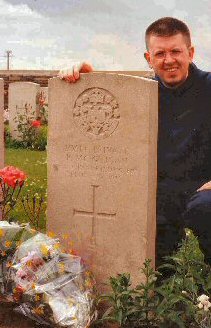
Our picture shows Sean McAteer of Warrenpoint visiting the grave in Northern France of his forebear Peter McGuigan of Cecil Street Newry who was killed in the First World War.  


Like many, Peter pretended to be older than his years – he was just fifteen and not eligible for military service – and the Army was happy to play along with this.  It happened again in WW2, my own uncle being one such boy soldier then.  He was injured and discharged with a decoration.  Young Peter in the First World War, like many others, was not so lucky.

Read morePeter McGuigan/Unknown Soldier