|
As we have already for other estates, we will shortly list the tenants of Linen Hall Square from another age. Meanwhile we reproduce here a short article that originally appeared two generations ago, extolling the new working class residences.
‘Upwards of 370 people once housed in slums now have what are probably the most unique homes in Northern Ireland. They live inside stone walls like those around a prison, but the gates have been removed and the residents have more air space than is usual for working class folks.
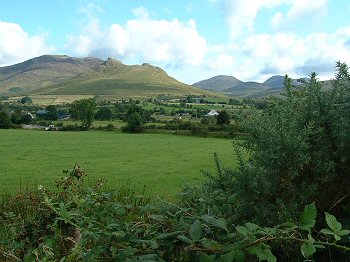
For the initial part of its lifetime Linen Hall Square was the location of the White Linen Hall, or exchange. Merchants met here to bargain for the linen woven on hand looms all over the country. For a few decades trade flourished, the linen being exported direct by sailing ship to all parts of the world. Political, market and economic conditions unfavourable to the Irish linen trade then saw a decline. Shortly after the Union the Linen Hall and its lands were occupied by the War Office and Newry became a military centre. Later still the barracks proved too small to accommodate whole regiments and for many years the buildings were only occasionally occupied. In 1927 the Urban Council acquired the Barracks and at a cost of c. £20,000 transformed the buildings into 74 houses. These were let at rents ranging from 6s-10d to 4s-5d a week. The migration of people from the old slums began – from tumbledown houses in crowded entries to a paradise of sunshine, surrounded by parklands. Situated on the north bank of the canal, the Square overlooks the most charming pastoral scenery. Each house had three or four bedrooms and a roomy kitchen. The chief drawback was that the houses stood back to back with no intervening yards. Still, the children had a playground of three acres enclosed from all vehicular traffic. Within the walls too provision had been made for the Fire Brigade, with a completely equipped station and residences for the Captain and the six permanent firemen with their families. There is an interesting story of a duel fought in the Military Barracks in the year 1804. The Royal Scots Fusiliers were stationed and the tragedy happened at the close of a day of General Inspection. A Captain and a Lieutenant had a disagreement about a parade ground order and a duel was arranged after dinner. The Officers Mess faced the canal and on the opposite bank the regimental band played during dinner. During the meal the officers involved rose from table and adjourned to the Smoking Room where recrimination began. It was decided to proceed with the duel using pistols. Back to back and stepping away, it was agreed to turn and fire after a set number of steps. One officer turned when only half the steps had been taken, and fired. His opponent, shot in the back, died immediately. The wrongdoer was tried and found guilty of murder. He was hanged in Armagh jail, that part of town then being in the County Armagh. A dramatic feature of the event was that the condemned Captain’s company was marched from Newry to Armagh to witness the execution, as an object lesson. The Captain’s wife, residing in Ayr, made a vain but heroic effort to save her husband, but her hasty journey to Ireland was too late, even for her to witness the execution. It is said that in a window shutter of a room adjoining the place where the duel happened, there remained the imprint of a bullet hole. In future orders to contractors working on the site, it was specified that there would be a liability of £100 on any workman who covered it up. It was kept as a warning to any young hotheads following on. Now the military have long gone and in place of drilling, we hear the jovial shouts of merry children. The bugle calls are replaced with radio music. Across the bank where the bandsmen heard the shot, are cattle now feeding on lush grass. The canal is as still as glass reflecting the shadows of the age-old trees, its surface only broken by the majestic swans that have made it their home. |