Is the aul’ hen dead?

shag.jpg
There was a beggar woman of old of these parts who had lost her arms in a flax-beetling mill accident.  (Beetling was a process where large and heavy wooden paddles were made to batter the linen cloth to smooth and shine it).  There were no compensation laws then.  Tramping the countryside she would have eaten haws from the hedge as she went along, being able to pull them off with her mouth.  She was heart-scared of dogs, being unable to protect herself from them.
 
Charitable people would take her in, feed, clothe and bathe her.
 
Other tramps were Red Margaret, Praying Biddy, Susie the Shoot and The Green Shawl Woman.  Mary Kelly was a tiny, old woman who wore a black cape.   Like Biddy Ardee they had bags and pockets to carry their little ‘charities’.  Soncy Mary dealt in cures especially for animals. 
 
Tramps at the door then might ask for money or a ‘grain of meal’.   A penny was enough to satisfy them, or bread or sugar or meal.   This went into their bag.  People kept a little ‘yalla male’ or maize (that ‘pigeon grain’ imported cheaply from America during the Famine) for this purpose.  
 
Daniel Murnaghan was noted for repeating The Lord’s Prayer as he tramped along.  Jack the Flute did this also.  He was called for the instrument he was heard to play.  He was known to run a piece, then stand and look around the countryside talking to himself.  
 
An old tramp was taken in to a big house once where he’d occasionally get a ‘piece’ and a mug of tea.  He was brought to the scullery of course and when seated in the charge of the sarvant girl, the lady of the house went off about her business.  There had been a ‘party’ entertained there the night before and the tramp was astonished to find a chicken leg between the boords of his ‘piece’.  Suspicious at such unknown largesse, he beckoned the girl to him and asked a whispered question:
 
‘Tell me Biddie’, says he, ‘whatever happened to the oul’ hen?’
 

Mummers Story

doctorsquarters.jpg
The Mummers tradition, I am told, was brought here with the Planters and might still be experienced in England’s South-West counties.  Rose McKeown of Sheetrim tells me they were still doing the rounds in that vicinity up to the early Sixties.  She has that character too as Wee Dibbley Doubt. 
 
They would cover an area of about five miles circumference.  This group had a French Fiddle (harmonica) for accompaniment and sang the popular songs of the time.  Besides the characters aforementioned she remembers King George.  They would perform in the kitchen, never getting access to ‘The Room’ which was far too grand for them!  The gloom of the old oil lamp added to the air of mystery!
 
At some houses they would get nothing and at others they might get as little as a sixpence, though half-a-crown was common.  By then they were primarily interested in the money.  She remembers giving a ten-shilling note.  She tells of one disguised figure commenting on her new Cuckoo Clock.  These were imported from Germany and hers was purchased above in ‘Cross (Carrickmacross) by her husband for seven pounds and ten shillings; a fortnight’s wages then.  Naturally she was very proud of it and it ‘cuckoo-ed’ non-stop for nigh on twenty years.   
 
Anyway when yer man commented on the clock he used her first name and an undisguised voice.  She recognised him as a former ‘flame.’  Perhaps that accounted for the generosity!
 
But I was trying to complete the script!
 
CROMWELL
 
Here comes I, Sir Oliver Cromwell.  As you may suppose
I have conquered many nations with my long and copper nose
I have caused my foes to tremble, and all my enemies to quake
Sure I bate me own companions till they were no longer fit to spake.
I shot the devil through a reel
And through an oul’ spinning wheel
Through a bag of pepper
Through a horse-shoe cocker.
Such a man was never known
And if you don’t believe the words that I say
Enter in Saint Patrick and he will clear the way.
 
SAINT PATRICK
 
Here comes I Saint Patrick in my shinin ‘ armour bright
I was once a noble champion, but now a worthy knight
I fed my sheep on oats and hay
And after that I ran away
If you don’t believe the words that I say
Enter in Beelzebub and he will clear the way.
 
BEELZEBUB
 
Here comes I Beelzebub
And over me shoulder I carry a club
And in me hand, a dripping-pan
And I count myself a jolly fine man.
And if you don’t believe the words that I say
Enter in Big-Bellied Ned and he will clear the way.
 
NED
 
Here comes I Big-Bellied Ned
If ye can’t give me money give me plenty of bread
For when I was young I was not well-fed
But now they call me Big-Bellied Ned.
If you don’t believe in the words that I say
Enter in Big Head and he will clear the way.
 
BIG HEAD
 
Here comes I that niver come yit
Big Head and little wit
The more me head’s so big, the more me body’s small
But I’ll do me best to plaze ye all
And if you don’t believe the words that I say
Here comes Wee Divil Doubt and he’ll clear the way.
 
DIVIL DOUBT
 
Here comes I, wee Divil Doubt
If ye don’t give me money I’ll sweep ye all out
(my mother has this line…The tail of me shirt is hanging out..)
Money I want and money I crave
If you don’t give me money I’ll sweep ye till your grave.
And if you don’t believe in the words that I say
Enter in Johnny Funny and he will clear the way.
 
We have earlier quoted Johnny Funny’s lines and the final chorus.
 
End…

Sligh Miodluachra

A1willRunOver.jpg
Five great roads emanated from the Hill of Tara in Meath (once again in the news as Bertie’s government controversially determines to drive a motorway through the vicinity!) to the rest of Ireland.   The northern-bound road, the Slighe Miodluachra, meaning the way of the middle rushy place, was well-named certainly as it traversed the Gap of the North at the townlands of Carrickbroad (the robber’s rock) and Edenappa.  This is the location of Kilnasaggart.
 

Read moreSligh Miodluachra

Mummers Rhymes

5meninhats.jpg
The Mummers were frequently accompanied by a few young men dressed in women’s clothes who gave an exhibition dance towards the end of the performance.  This was often the most enjoyable event.  Aware of how ludicrous they looked in corsets and petticoats, and much-befrilled and well-starched giant-sized white knickers, they lepped, kicked, danced and besported themselves to riotous music and song.
 
The Rhymers were popular with all creeds and classes and increased their popularity and topicality with personal and political verses.  There were ballads too concerned with love affairs of the district and peculiarities of individuals of the immediate neighbourhood.  
 
There were versions in different neighbourhoods.  This is just one.
 
Master of Cermonies:
 
Room, room, brave gallant boys
Give us room to rhyme
Till we show a bit of our activity
At this Christmas time.
Active youth and active age
The like was never acted on a stage
If ye don’t believe what I say
Enter in St George, and clear the way.
 
St George:
 
Here come I St George, from England have I sprung
And many a noble deed of valour have I done
For years I was in close quarters kept
And out of that into a prison leapt
And out of that into a block of stone
Where I made many a sad and grievous moan
Many a giant did I subdue
And I ran the fiery dragon through and through
I fought them all courageously
Until I earned the victory
Show me the man that dare me stand
And I’ll cut him down with my courageous hand.
 
Turk:
 
I’m the man that dare ye challenge
Though your courage be so great
With my sword I make all to shake
Even dukes and earls to quake.
 
St George:
 
Who are you but a poor silly lad?
 
Turk:
 
I am a Turkish champion
From Turkey land I came
To fight you, the great St George be name
And I say, by George, you are a liar, Sir!
So draw your sword and try, Sir!
 
St George and the Turkish champion engage in sword play.  The Turk falls and his mother enters weeping and wailing..
 
Turk’s mother:
 
St George! St George! Oh, what have you done?
You have killed me only son.
See him lying bleeding there
Oh, my heart is sinking in despair.
 
A doctor, a doctor, ten pounds for a doctor!
Is there ne’er a doctor to be found?
Who can cure me son of his deep and mortal wound?
 
Enter the Doctor.
 
Turk’s Mother:
 
Well, doctor, what is your medicine?
 
Doctor:
 
Hens’ pens and Turkish treacle
Bum-bee eggs and midges’ bacon
Stirred up with a great cat’s feather
Mixed in a mouse’s blether
And given thrice a day.
 
Doctor attends to the Turk.  He sits and gives thanks.
 
Turk:
 
Once I was dead but now I’m alive
God bless the wee doctor that made me revive.
And if you don’t believe in the words I say
Enter in Sir Oliver Cromwell
And he will clear the way.
 
More….
 

Use of a Handkerchief!

tichulainnring.jpg
You may have wondered why there’s just the tumbled remains of a forth in this picture.  Well, I’m going to tell you!
 
A man that lived hereabouts one time went so far as to drill holes in the rock under some bushes, ready to take blasting powder to it.
 
Then he took a break for he’s dinner and when he come back he found the track of a foot in the loose mould, and a penny, a pipe and a candle lying on the stone.
 
Well it was, that he knew that these were the symbols of a wake, so he abandoned the work!   


This is also one of those fields where manys the time people at night got stuck in it and couldn’t find the pad out!  There was only one solution, if you weren’t to wait there till morning!
 
You had to turn your coat inside out, to tie three knots in your handkerchief and then to sit down for a while. 
 
Then you would see your way clear again!

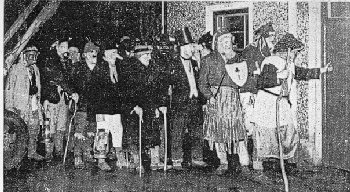
Mummers, Sheetrim, 1930s

Mummers1.jpg


‘Heartsore imagining the years without
The Doctor, Darkie and Wee Devil Doubt.’
 
This couplet from Hewitt’s ‘An old woman remembers.. Christmas 1941’ reminded me of my earlier promise to return to the story of the Mummers.  They were also known as the Christmas Rhymers.  My mother recalls their visits to her home in Sheetrim, Cullyhanna in the 1930’s and, bless her, still has a few of their rhymes.  The characters altered a little (or is it my memory, asks Eileen?) with the latter named then known as Wee Dibbley Doubt, and the Doctor given the surname Brown..
 
‘Here comes I, Doctor Brown
I’m the best doctor that’s in the town..’
 
She doesn’t recall any Cromwell, though with the big, false nose, he was a persistent character in most localities.  There was however a Jack Straw and a Funny Face.  Nor does Mother remember any barbs directed at local characters or political personalities, but she would hardly have understood then being just a young girl.  
 
In addition to being a continuation of long custom and tradition, the Mummers were a much appreciated travelling drama troupe in a country area that had none other.  This one had no costume department and the characters were dressed in apparel they made themselves, with much straw ropes in view, coats worn inside out and hats garnered with wisps of hay.  The sword fight scene was common to all, the injury requiring the entry of the Doctor.  Some had soot-blackened faces which gave us the character of Darkie.  I haven’t yet evinced from Mum the name of any of the songs they rendered.  Can anyone help?
 
I am envious of course, the modern re-enactment scarcely making up for the kitchen drama, learning the songs and rhymes, guessing real identities behind the costumes and masks etc.  The entry of Johnny Funny sadly presaged the entertainment’s end, there following just the choral rendition of tribute and thanks to the home’s master and mistress.
 
‘Here comes I, Johnny Funny
I’m the man that lifts the money
All silver, no brass
Bad ha’pence won’t pass
Send the farthings to Belfast’.
 
All gather round to finish..
 
‘God bless the master of this house
Likewise the mistress too.
May their barns be filled with wheat and corn
And their hearts be always true.
A Merry Christmas is our wish
Where’er we do appear
To you a well-filled purse
A well-filled dish
And a happy, bright New Year.’
 
Which is our greeting to all our patrons on Newry Journal!

Travelling Companion

jimmurphy.jpg
A certain young man climbed on board of the overnight ‘sleeper’ train alone.  He did not intend to fall asleep and he hoped for an interesting or amusing companion with whom to while away the hours in conversation.  Suddenly walking up the carriage he spotted the most beautiful, shapely young blonde he had ever seen.  Please, please! He thought. 
 
Sure enough, she took the seat beside him.
 
Giving her a few minutes to settle in, he finally opened a conversation.
 
‘Excuse me, miss, is this a business or pleasure trip?’
 
‘Well, both.’  She spoke gaily and with easy fluency.
 
‘I’m going to a Nymphomaniacs Convention.’
 
He gagged, but finally recovered enough to speak again.
 
‘If you don’t mind me asking, what do you do?’
 
‘Oh, I don’t mind.  I’m a lecturer.  I’m delivering a lecture on ‘Common myths of sexual mores and practices.”
 
‘Very interesting,’ he managed to splutter.
 
‘It is really, you know.  For example there is a commonly held myth that the best endowed men are Afro-Americans.  They’re not.  It is the American Indian who is.’
 
‘Yes?’
 
‘And French men are said to make the best lovers.  Not true, either.  It is the Greeks.’
 
‘Really?’
 
‘But excuse me, how rude I am!  I neglected to ask you your name.’
 
He took a deep breath.
 
‘Oh, me?  My name?’ he answered.
 
I’m pleased to meet you.
 
My name is Tonto Papadoupalis!’