Ghostly Horse Rides Again

mountstpksmall.jpg
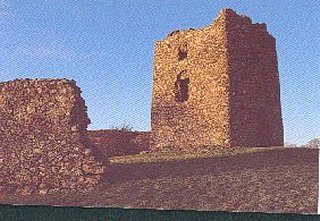
I earlier mentioned that the life and fortunes of Dostoyevsky – and one of my own line – was ruined from gambling.  This is a tale of a Planter of these parts who ruined himself from the same addiction.

 
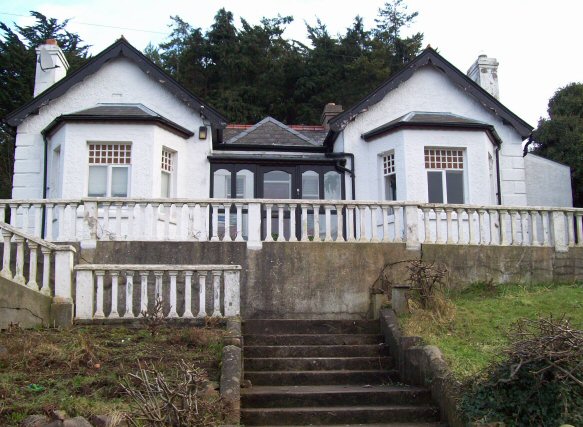
William Fivey of Lisnabrague Lodge, near Poyntzpass owned land both there and at Killycomain (near Portadown).  The Ordnance Survey Report for 1837 shows that he leased land in parcels of 3-15 acres at 25s-28s per acre for the former location and at 10-20 acres at 20s-40s an acre at the latter.  He was a very wealthy man and also had a lime kiln and several mills. 
 
However he was a profligate gambler and owned several racehorses.  Over a period of time he experienced much ill-luck and soon was in dire financial straits.  He decided to gamble everything on one final fling.
 
He owned one particular racehorse in which he had undying faith.  He prepared and trained it well and entered it for a race he felt certain it must win.  He gambled all the money he had left in the world on the outcome.
 
It lost.  Fivey in fury took the horse home and stabled it.  Then he had the stable door bricked up and the horse starved to death.
 
By 1850 Fivey was forced to sell all his horses and his furniture to meet gambling debts.  In the end he had to let Union Lodge to a Doctor Saunderson.
 
 
To this day a ghostly horse is said to gallop up the avenue on moonlit nights from time to time.  There are those who would deliberately avoid the area then. 
Iraq of Old

fromair.jpg
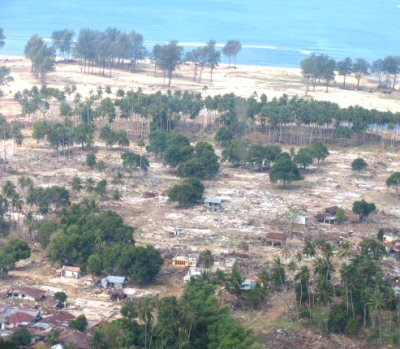
Fallujah in Iraq has just suffered the fate of Grozny in Chechnia – bombed and razed and uncounted thousands of its inhabitants slaughtered in a vain effort to ‘restore order’.  Now it’s the turn of Mosul and still no end in sight! 
 
We sometimes forget that this was the cradle of civilization.  I read the following moral tale today and thought I would share it.
 
‘In ancient Baghdad there was a rich and powerful merchant with many servants but one he trusted with special tasks.  One day he sent this servant to the market place on an errand.  When he came to the market place this servant saw Death standing there and Death gave him a strange look.  The servant was greatly afraid and ran back to the master’s house where he told the other servants what he had seen.  
 
‘He has come for me,’ he said.  ‘But I will take my master’s fastest steed and ride like the wind to Samarra. I will be there by nightfall and Death will never find me there.’
 
The other servants went and told the master.  He was very angry.  He strode off to the market place and Death was still there.
 
‘What do you mean by giving my servant such a strange look and frightening him?’ he demanded.
 
‘I was merely surprised to see him, that’s all,’ Death replied.
 
‘You see, I am to meet him this night in Samarra’.
 
 
Many continue to meet Death this and every night in Samarra, Fallujah and Baghdad.  Margaret Hassan, we learn now, has already been brutally executed.  
 
We celebrate the release of Annetta Flanigan and her two companions in Afghanistan, whatever the circumstances of their release.


Do You Remember?

DeanWomen.jpg
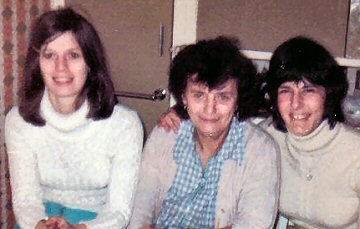
A bucket on the stove boiling all the whites
The big tin bath on Saturday nights
An old glass washboard, an outside loo
Distemper on the walls, cardboard in your shoe?
Lino on the floor, a scullery out the back
A coin in the meter, coalbrick, coke and slack?
Keys in the lock, door on the latch
Long, hot summers, ponies and traps?
Blackleaded range, mansion red tiles
Rag men, bone men and men who sharpened knives?
Ardglass herrings, buttermilk and snuff
Sore heads, stomach aches, tripe and onion stuff.
 
Sennapods, virol, castor oil and malt
A poultice for sore throats made of hot salt
A half-moon waterwark like a front-door mat
Soda farls, wheaten farls, cooling on the rack.
Sheets made from flour bags, winding-up clocks,
Suspenders for men, holding up their socks.
Crombie hats, paddyhats, corner shop small
Horse-drawn hearses with black plumes tall.
Gas mantles, lamplighters, billycans of tae
Walking home from dances, courting on the way.
Fish an’ chips in newspapers, a pennyworth of jam
A pound of broken biscuits, a trolleybus and tram.
Donkey’s hoof, pinade, crocks and beetles too
Rinso, Vim and soapflakes, newspaper in the loo.
Carbolic soap, Brylcreem, seven o’clock blades
Sugar and water potion making permanent waves.
Ale plants growing in a big sweet jar
Food safe with wire mesh in every back yard.
Hotspur and Rover, Dandy, Beano too
A 3d matinee or a jampot in lieu.
A refund on bottle, brown paper bags
Five Willie Woodbine or sharing a fag.
Hoops and cleeks and guiders, parries, whips and all
Skipping songs, marble, pitch and toss, handball.
Top 20 from Luxembourg, Desert Island Discs
Henry Hall’s guest night, rock ‘n’roll and twist.
Billy Cotton’s Band Show, a book at bedtime too
The list is never-ending – but who was ‘skiboo’?

Poor Law and Tramps

fairday2.jpg
John Mitchel is even today frequently lambasted for claims he made that British policy towards Ireland after the Union was deliberately designed to remove the great mass of poor from their holdings, the land, the country and the face of the earth.  Yet Reports from Commissions of Inquiry set up by successive British governments – and action (and inaction) taken as a result – give strong if circumstantial evidence in support of Mitchel’s words.
 
The Devon Commission of 1833 estimated that of the country’s population of over 8 million, some 2,385,000 were ‘in great need of food’.  Its strong recommendations for urgent investment in wealth- and  employment-creating schemes went unheeded and the Government went ahead with the Workhouses designed to deter the ‘work-shy’.  The subsequent potato failure and Great Hunger, disease, campaign of farm-amalgamation, dispossession, eviction and enforced emigration saw a massive shift in the population profile by the end of the century.  The Vice-Regal Commission on Poor Law Reform 1906 blamed famine, disease, eviction and emigration which affected the poorer classes more than most.
 
The latter Commission in 1906 estimated some 30,000 of a population of four and a half million to be dependent upon Poor Relief.  (The numbers again dropped dramatically from 1908 onwards with the introduction of Old Age Pensions).  This was less than one per cent compared with thirty per cent of a population twice the size, some seventy years previously. 
 
Where had they all gone?  We will soon upload a personal story of an ‘American Wake’.  A sizable fraction of those who had not fled the country had died of disease or hunger.  The suffering of the poor was hugely disproportionate as a  result of deliberate Government policy.
 
Of the 30,000 mentioned, some 2,000 were classified as vagrant or tramps.  The Commission estimated that eighty per cent of these were male.  They were of two types, one being old and infirm but basically decent and generally well-known and respected within their own locality.  The other type has for centuries been the greatest object of hatred for governments: the ‘young and able, lazy ne’er-do-wells, dishonest and potentially dangerous’.  The Commission recommended the setting up of Labour Houses wherein they might be confined to learn ‘habits of sobriety, regularity and industry’. 
 
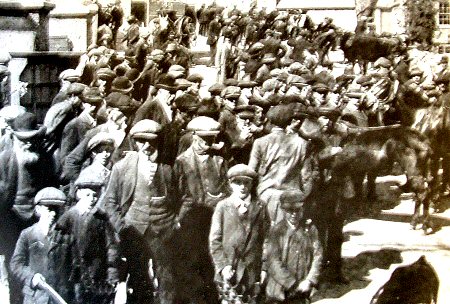
The Newry Reporter and other local papers reported the activities of tramps in this area – ‘infested with a tramp plague’ was a commonly heard expression – and special courts were frequently convened to deal with the problem.  For begging, two months in prison with hard labour was a regular sentence.
 
Yet then (and before and since!) there was a great deal of local sympathy especially for those tramps who were recognized simply as colourful characters. 
 
We have featured a number.  Later a few more.

Church at Kilnasaggart?

MoyryCastle.jpg
The Kilnasaggart Stone plaque recently referred to continues with a description of its carvings:
 
‘On the north-west face are ten carefully-carved crosses, nine of them within circles and, low down, a number of parallel linear marks, once interpreted as a possible ogham inscription but actually knife-sharpening score marks.  Traditionally a crock of gold was buried below the pillar and it was overturned by treasure-seekers in the 1830s, but it was soon reset.
 
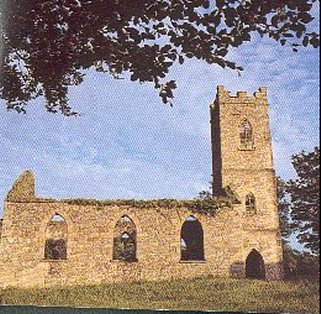
Excavations in the 1960s to the south of the pillar revealed a number of both stone-built and dug graves, probably dating from the Early Christian period.  A map of 1609 shows a ruined church in this area but there are no visible remains and no trace was found during the excavation.’
 
Your editor considers that the early 1960s excavations of this, the Slieve Gullion tombs, Ballymacdermott Court Cairn etc. were less that complete and must at best be treated as indicative.  We baulk at terms like ‘actually’ above, used in relation to a dubious theory at best.  The stories of the cemetery excavation – and the overturning of the pillar in search of booty – have already been related here.  The sentence beginning, ‘Traditionally a crock of gold was buried below the pillar..’ is at best unclear and at worst an unintended enticement to further vandalism.  There is certainly no evidence to support the allegation.  There is no indication of the possible greater antiquity of this standing stone already debated here (and on Guestbook).
 
Though there is no extant evidence of an early church on the site, we believe the circumstantial evidence (the location at the Gap of the North on the ancient Slighe Miodluachra (next story!); the overscored Christian symbols on a more ancient pillar; the nearness of Moninna’s convent at Killeavy and that of Bridget at Faughart; the 1609 map; the name, Kilnasaggart meaning Church of the Priest) points to that distinct possibility.

From Irish, Placenames

BdgeStCrossing.jpg
The many explanations of the Gaelic derivation of local place names is often a cause of exasperation.  That we cannot be prescriptive is a testimony of the name’s antiquity; it also reflects on the possibilities of both languages; and it frequently tells of our diverse history and demonstrates that no matter who we are, we share a common rich heritage.  Here are just two examples that we have recently referred to.
 
The village of Forkhill, recently featured (and about to get another article!) lies beneath Slieve Gullion’s tail.  Older residents say ‘Far – cill’.  Some believe it refers to an ancient clan, Orcaill.  Others suggest it comes from the Gaelic for Cold Wood, and indicate that the famous and ancient Dunreavy Wood ended at the village. 
 
I have been told its derivation is from a Gaelic word referring to a water course or ‘trough’.  Personally I suspect it might derive directly from ‘Church of the Men’ as we have Church of the Priest (Kilnasaggart) and Church of Women (Kilnaman) too. 
 
But merely contemplating these alternatives causes us to remember ancient clans and their names; to recall that until a few short centuries ago, our land was covered in forests, and to remember tales associated with Dunreavy Wood; to consider the river, lakes and unique water features of the area and how they were developed in the past; and to accept the central role of religion and particularly Christianity in the last two millennia.
 
And Slieve Gullion itself.  The term in English refers to a body of still water in a ‘gully’ possibly and may refer to the lake on the mountain top. 
 
It may however derive from the Gaelic for ‘holly’ with which the mountain was once covered. 
 
It may derive from Cullain, the smith to the court of Conor McNessa and the Red Branch Knights; or to Cuchullain whose greatest exploits happened in this vicinity and whose name means Hound of Cullain.
 
I have also heard it suggested that the clouds and mist that frequently cover its top may have brought about a name that could possibly derive from the Gaelic ‘to cry’; and again, that verb along with the name of that other hero, Fionn (MacCool). 
 
So, how many tales, legends and stories of folk history does that conjure up?
 
Let’s just celebrate our diversity and the richness of our common history!

Panorama of Newry

This panorama provides a view over Newry from the Bernish viewpoint taken on St Stephen’s Day. The snow  provides an excellent backdrop. Wait for it to load. ‘Pan’  back and forward by moving your mouse pointer across the photo.  To control speed, position mouse pointer in middle.


Read morePanorama of Newry