Emergency Procedure

albertbasinfair.jpg

Now be honest!!

After H M Government went to the trouble and huge expense of circularising every home with their timely and very informative booklet PREPARING FOR EMERGENCIES, you simply browsed it quickly, read the final summary [Go In, Stay In, Tune In] and then threw it out! Didn’t you?

You may, like me, have mentally noted the contrast with the Fire Service’s advice of Get Out and Stay Out and remarked that one likely emergency would be of your home in flames after an attack.

Ah, but you’re just being pedantic! Fire’s fire but a terrorist attack is different!

Well, except for the Twin Towers, Bali, Philippines, Turkey, Iraq, Nairobi etc. Anyway there was much more to the booklet than that and we would like to summarize its contents, now you’ve already binned it.

HOW TO RECOGNISE A TERRORIST

As your Government Ministers, politicians and police repeatedly inform you, terrorist incidents are always instigated by outsiders infiltrating an area. So your typical terrorist is definitely NOT ONE OF US!

He/she is ‘from the other side of the house’, of different ethnic origin, swarthy, usually with an ugly scar across his face, some broken teeth and wears an evil grin at all times. Do not be surprised if he carries a heavy suitcase monogrammed with the letters WMD. Should he attempt to pretend that his name is William Martin Drennan, or some such, you may show your erudition by boasting that you recognise the initials as ‘weapons of mass destruction’.

HM Government, long seeking that very thing, would like to hear from you should this contingency arise.

TUNE IN

In the case of future emergencies, the Government will filter and control information released to the public.

This is to offset the panic that arose for example, on the morning of 11.09.01 when unfiltered data was aired to the effect that the US Air Force had been scrambled with orders to shoot down any civilian aircraft still aloft after a short period. It was also suggested then that dozens of hijacked planes were in the air and had been long enough to now have even crossed the Atlantic, should that be the intention. Later events proved otherwise: the US Air Force, for example, never left the ground (unless there’s truth in the rumour that the last plane that ‘crashed’ in open country was in fact shot down, that morning).

Rest assured that only good and reassuring news will in future be aired on radio! Remember, if it comes from your Government, it is GOOD.  Otherwise it is just propaganda.

DON’T PANIC!!

First VERY IMPORTANT lesson is not to PANIC.

All right, the imminent attack might take the form of a 100-megaton nuclear device landing in your garden. Frankly should that happen, you’ll never know a thing about it. It could be a deadly nerve gas seeping under your door or rising up through your drains. Again, you’ll have no call to worry, for you’ll be gone before you know it!

It could be a deadly toxic virus in powder form sent through the mail to you. Don’t at any cost open any mail that does not bear the H M Government logo on it. And even then, call the Army Bomb Squad before venturing to open any package leaking white powder.

Or indeed powder of any other colour.  Fiendishly clever, these terrorists!

TAKE TO YOUR SHELTER!

As soon as possible build a reinforced bomb shelter in your garden. Make certain you dig deep enough to access the local water table, for fresh water supplies might be a problem in the event of nuclear attack. Should you be fortunate enough to live on land with a natural spring, why not build a shelter large enough to accommodate your whole neighbourhood?

RECOMMENDED FOOD PRODUCTS

Stock up with enough food to last for years.

We recommend 36 sacks of Neill’s Flour, 12 crates of Nestle’s Pot Noodles, 4000 tins of Heinz Baked Beans and 20,000 6-packs of Harp Lager. [H M Government is indebted to Neill’s, Nestle, Heinz and Harp for sponsoring this booklet!]. Please don’t forget you will need a tin opener! With such a diet, don’t forget to include a double-valve flue system to vent off human gas. The second valve is to prevent the entry of radioactivity from outside, which, if such a thing is possible, is even more toxic!

DOMESTIC PETS

At first hint of attack, kill, skin and bone all domestic pets and store the meat in the domestic freezer you will naturally have included in your bomb shelter. A petrol-driven generator will be required, but we would urge people not to stock up with extra petrol/diesel supplies, otherwise our oil might run out soon – what with Iraq, Saudi Arabia and all the rest.

MEDICAL AND SANITARY SUPPLIES

Stock up with all the usual medical supplies. We recommend Haliburton brand products since the Board of that company has made a small contribution towards our costs.

This pamphlet, which is printed on recycled paper from sustainable forestry, might itself be recycled to make the equivalent of ten sheets of luxury toilet tissue.

Further recycling is not recommended.

BOMBS

If a bomb goes off outside your building, stay inside in case there is a second bomb in the area.

If you saw the explosion, stay in the area and tell the police what you saw (unless, of course, you have reason to believe there is a second device in the area). In the latter case, get out and tell the police later. They would like you to help with their enquiries – for example, how come you knew there was a second device planted??  Would you prefer to be questioned at the police station or Quantanamo Bay, Cuba?

IF ENGLISH IS NOT YOUR LANGUAGE

How did you get this far if you don’t understand English?

Anyway, the pamphlet is available, should you require it, in Urdu, Estonian, Malibu, Rhumbabese, Salami and Clotted Cream flavours. Gaelic and Ulster Scots versions will follow soon – emergencies permitting. 

TRUST YOUR GOVERNMENT:SAFEGUARD DEMOCRACY: VOTE FOR US!

The pamphlet is for emergency guidelines only. DON’T PANIC. Your government is in control.

Have we ever lied to you?

We promise, when it is time to PANIC, we will give you 45 minutes notice.

P.S. A few handy hints.

If you find yourself trapped in darkness in a bombed building, do NOT search for gas leaks with a lighted match or candle.

Stay close to walls and tap on pipes so that rescuers can hear you. If you don’t smoke a pipe, perhaps you could sing – or call out, if you don’t feel like singing!

If an escape door feels hot, there’s likely to be a fire at the other side. Don’t open it, unless it’s the only way out. In the latter case, go for it. You have no alternative.

Remember the old adage, Women and Children First. If you happen to be a man, you may choose to ignore the adage.

Get to personally know your local police, Fire Workers and Emergency Service Personnel. This may win you preferential treatment in an emergency! (But keep your hands off the big brawny fireman with the cute dimple on his left cheek. He’s mine!). Such familiarity will help you distinguish between genuine Emergency Personnel and terrorists disguised as such.

Yes, they will even stoop as low as that!

For further information, log on to our website everymanforhimself.com.
The Stranger

HooksEntry.jpg
As she stepped off the coach it started to rain.  She didn’t mind.  She was home ………home again after so many long years away.  It would take more than the weather to dampen her spirits!  And anyway, it wasn’t really proper rain!  It was a fine soft drizzle and as she lifted her face to the sky, it felt warm on her skin.

She collected her luggage and moved quickly to the river wall.

Read moreThe Stranger

Where are the Sessions?

alfie-small.jpg
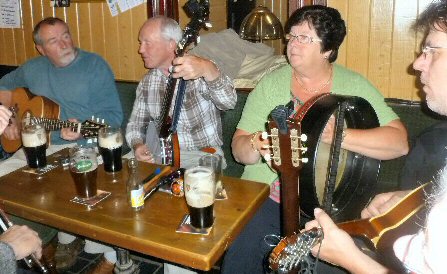
It is now Sunday afternoon and after dinner my wife and I will go to Rostrevor for the opening of the Fiddler’s Green Festival.  I shall avoid the Derry self-publicist and listen to Burn the Whins.  This is a highly-talented local (Mayobridge) folk group that includes mandolin player Robbie Dinsmore and multi-instrumental singer/songwriter Loretta Phillips.  This pair also play with many others, every Tuesday night at The Cove, Derrylacka.  I asked Loretta to name the local ‘sessions’ for visiting tourists, who might not be so lucky as to have the Fiddlers when they visit us.   
 
‘Our Tuesday nights out at Gerry and Coleen Guest’s pub is normally a quiet, self-indulgent session, but ideal for tourists and locals alike, who enjoy the music but like to converse among themselves at the same time.
 
It’s not always that quiet!  Among the musicians who regularly attend are Willie O’Hare on fiddle, Benny Sands (vocals, banjo etc) and wife Barbara (bohran), Charlie McGeown (fiddle) Benny McKay, Eddie McIntyre (accordion) Eddie Ruddy (whistle) and of course, ourselves.  Ten till one.  Come!
 
There’s another great session on Tuesdays in Forkhill.  Famous guest artist featured weekly, then over to the regulars.  You might get an aul’ story too from Michael Quinn!
 
A few miles away Bernard O’Hanlon has a regular weekend session in Mullaghbane, I’m not sure now whether it’s Friday, Saturday or Sunday but give him a ring!
 
Rostrevor has two mid-week sessions, on Tuesday nights in the Corner House and the Kilbroney Arms on Wednesday nights. 
 
Tuesday nights seem the most popular.  P J O’Hare’s in Carlingford (where I’d be attending the Four Pennies al capella jazz session at this minute if I wasn’t preparing to go to Rostrevor)  usually has Deidre Rodgers, Gerry O’Connor, Gerry Donnan and M Farrell playing.  Now, there’s a line-up!
 
There are also Friday night sessions (once a month) in Bryansford and Maghera (the Co Down one!).  
 
I’ll not mention the Thursday night Railway Bar, Newry session for you’ve advertised it already.
 
Do you think that will be enough to keep your visitors busy?’
 
Well, Loretta, what with the recently-completed and highly-successful Warrenpoint Ulster Fleadh, the Maid of Mournes, Fiddler’s, Lislea Summer Drama and all the rest, I think so.
 
Must hurry.  Can’t miss Loretta in Rostrevor.  
 
P.S. She’s gorgeous and charming as well.  Oh to be youthful again!

Frank Carroll: Missionary

PopeandFrank.jpg

Attending the Abbey Grammar in the ’60s we could look out a window to the home at 71 Castle Street, of Archbishop Francis Carroll.  The Christian Brothers never tired of lauding his praises as the greatest of their past-pupils.  Perhaps we were too young or sceptical then to appreciate their words.  To show they were not – in the words of my old mentor, Paddy Arthur Crinion – ‘wasting their sweetness on the desert air’, I post this tribute!

Francis Carroll was born the son of Patrick and Mary Carroll and attended the Abbey Christian Brothers School in Newry.  Deciding to become a priest he studied theology at Dromantine until June 1937.  He was one of eighteen priests ordained by Bishop Mulhern in St Colman’s Cathedral in December 1936.  Frank was to have a distinguished missionary career in Africa.  Attempts to establish a mission in the Monrovia district of Liberia had met with limited success before his arrival.  Liberia was (and is) an impoverished country with a dispersed population, simmering political unrest, poor communications and a virtual absence of medical facilities.  The difficult climate – just a few degrees from the equator, and known as the Whiteman’s Grave – the isolation and the poverty exacted a heavy toll on members of the Irish province of the SMA. 


Frank took charge of a mission composed of young and inexperienced priests.  His jurisdiction on the Kru Coast was accessible only by sea and was the least developed region of that underdeveloped republic.  Yet through his energetic and outgoing personality, his excellent relations with the indigenous population and with the Americo-Liberian government of President Tubman, his clear conception of what he required, his skill in obtaining funds and his exceptional ability to ‘get things done’, he succeeded in transforming the moribund coastal mission of 1951 into the thriving, vigorous mission of 1958. 


Frank’s achievements when he became Bishop were no less impressive.  His skills as a diplomat when he later served as apostolic delegate and Vatican representative were of inestimable value.  For his lifetime’s work Frank was four times decorated by the Liberian government for outstanding services to the nation in education, health, social welfare and evangelism.  It is a tragedy that the ‘country of the freed slaves’ today does not have the services of one of his qualities.  Liberia unfortunately is once again one of the most afflicted countries on the African continent.


Frank Carroll’s remains lie in St Mary’s Cemetery.  An obituary by a senior colleague summarized his life’s work:


‘A missionary in Liberia for forty-two years .. when Archbishop Carroll retired he was beyond question the foreigner who knew more Liberians from all walks of life and all social classes than anyone else.  All this time he promoted Liberian education at every level.  He took particular interest in the poor and the sick, establishing orphanages and clinics throughout the country.  His door was always open not just to diplomats and government officials, but to the poor.  He gave particular attention to youth.  In a country where Catholics are a small minority he made the role of the Church appreciated by all.  He leaves behind the memory of a man of deep faith who had a great love for the people of Liberia.’  And for the people of Newry, I might add.  May he rest in peace. 

Dromantine History

MillenniumWindowDrom.jpg
Dromantine will be extensively featured on Newry Journal for a short while.  Every Catholic (and we hope, many of other faiths and none) is familiar with Dromantine Sundays, a fun day organised to raise funds for the SMA [Society of African Missions] when the beautiful grounds of this most impressive estate are open to all.  The College now serves mainly as a Retreat House and no finer place for such activity could be imagined.  The well-kept grounds, the extensive lakeside walks, the impressive 19th century country house, the new Conference Centre, the goldfish pond, the drumlin countryside panorama – it is the perfect place to de-stress and reflect on the spiritual and contemplative life, and all within a few miles of Newry centre! 
 
I will shortly feature the work in Africa of one of Newry’s greatest sons, Bishop Carroll of the SMA, who was trained at Dromantine.  Then I intend to summarize the centuries of history of this great area, its people and the estate.  Finally I will refer to the recent renovations and the role of the College today.  First, a short summary of IMPORTANT DATES.
 
The Magennis clan was for centuries the ruling clan in Iveagh, an extensive area covering most of the present day’s west County Down and reaching from Lough Neagh in the north to the Irish Sea in the south.  Some leaders occasionally participated in the resistance to the encroaching powers of the Normans and later, the English.  Most however, took a more pragmatic approach to ensure their survival.  Thus in the seizure and ‘re-grant’ era of the early seventeenth century, Arthur Magennis, in 1611, received 4,200 acres in ten townlands within the precinct of Clanaghan (Glen).   The Magennises continued in ownership for a century and a quarter.
 
1611  Arthur Magennis receives Dromantine in ‘re-grant’.
1737  Dromantine put up for sale.
1741 John Innes of Scotland buys Dromantine.
1808  Building of the present house.
1810  Construction of the lake.
1859  Extensive construction work on House.
1865  Work on House completed.
1922  Dromantine House bought by Samuel McKeever.
1926  The Society of African missions buys Dromantine.
1927  First eleven of 587 priests ordained.
1931  St Patrick’s Wing built.
1935  St Brendan’s Wing built.
1936  Work begins on Chapel.
1959  St Colman’s and Assembly Hall opened.
1974  Dromantine closes as a Seminary.
1975  Dromantine opens as a Retreat Centre.
1998  Major renovation work begins.
2001  Renovation work completed.

Ballymoyer House: National Trust

ballymoyer house
The Synnot family soon after arrived in the parish of Ballymoyer and leased eight townlands from the See of Armagh.  In 1778 Sir Walter Synnot [High Sheriff of County Armagh 1783] built the original Ballymoyer House in the townland of Ballintemple.  The family was involved not only in the linen trade but also owned lead mines in the vicinity. 
‘The lands were healthy and barren previous to 1778, when Sir Walter Synnot erected a house and became a resident landlord; scarcely a tree or shrub was to be seen and the agricultural implements were of the rudest kind.  He constructed good roads in the vicinity and planted forest trees [Lewis S. 1837].’

The Ballymoyer House Demesne Was Extensive and Ornate

‘The mansion built by Sir Walter Synnot and the demesne attached to it is laid out and planted in a tasteful style.  Three mountain streams after debouching from the glens of their upper course, unite in the lawn and form a scene both beautiful and romantic.'[Parliamentary Gazetter 1844].
By 1838 the family had bought the eight townlands and continued to improve the estate.  By the latter part of the 1870s they owned 7,321 acres.  In 1901 the demesne had passed through marriage to the Hart-Synnot family who presented it to the National trust in 1937.
Today Ballymoyer (estate and woodland walk) is still a National Trust property and is well worth a visit.  It is located close to Whitecross, nine kilometres from Newry and four kilometres from Newtownhamilton.


Abbey Newry History …

Read moreBallymoyer House: National Trust