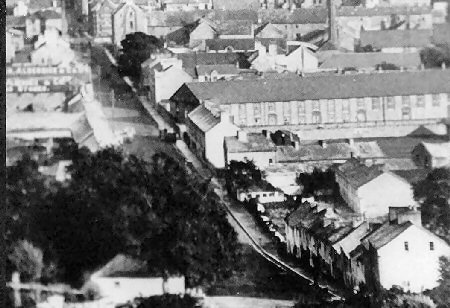
We previously covered the 1975 Monaghan Street residents. Now we move past the roundabout and up Monaghan Row!
 John McCullagh
Boys of Mullaghbawn
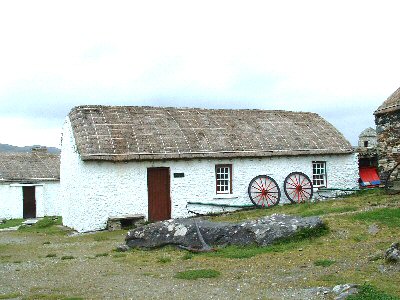
On a Monday morning early
my wandering steps they’d lead me
Down by a farmer’s station
through meadows and green lawn
I heard great lamentation
the small birds they were warbling
We’ll have no more engagements
with the boys of Mullaghbawn
I beg your pardon, ladies, but grant me this one favour
I hope it is no treason on you I now must call
I’m condoling late and early, my heart is near to breaking
All for a noble lady that lives near to Finnae
Squire Jackson he’s unequalled for honour and for reason
He never turned traitor nor betrayed the rights of man
But now we are in danger from a vile deceiving stranger
Who has ordered transportation for the boys of Mullaghbawn
As our heroes crossed the ocean I’m told the ship in motion
Did stand in great commotion as if the seas ran dry
With the trout and salmon gaping the cuckoo’s left her station
Farewell to old Killeavey and the hills of Mullaghbawn
To end my lamentation we’re all in consternation
For want of education I here must end my song
Who cares for recreation without consideration
We’re sent for transportation from the hills of Mullaghbawn.
Submitted poems : reflections
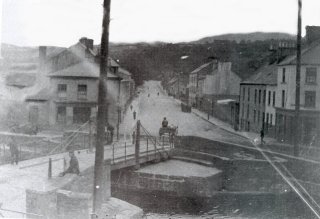
Of these three submitted poems, two (namely ‘McParland’s Elder’ and ‘McGinn’) are character based poetic fictionalisations of various characters in and around the town (McParland and McGinn being two distinctly local surnames). ‘McParland’s Elder’ is an ode to the elderly of the city whilst ‘McGinn’ is the story of a man observing his own wake and funeral (not very cheery, granted, but very Irish in it’s outlook nonetheless).
The other poem ‘Going to my Hometown’, is a sonnet written in dedication to the city and was inspired by many of the landmarks dotted around the place (namely, the old red-brick of the Hibernian Club on the Mall and the medieval church up on High St.)
Going to my Hometown
Parading a musty clop along the mall;
Redbrick and granite should glimmer in their boast.
Razing a glint in bier-garten toast,
I’m jealous – their sip, lip-locked – I’m enthralled.
The chivalrous sweat in musical droves,
Saluting the weather with world-weary wink.
The steeples, serene, without rain to drink:
A clan wry, a-flowing – a city of mauve.
Borderline bubble I love you so well.
I source you for boredom, ‘tis true, ‘tis true,
For dryness can seem here the hottest of hells
But I would be dead if ‘twas not for you –
A cynic. A liar. A lover. A son –
A soul wracked to bone mass from valley-sought glue.
McGinn
I
Thespian legion of repute and rogue
Wherefore to season my home with your lease?
Cast without shadow and latent in vogue
Celestial yearnings burn without cease.
For human endeavour seems that of beast
When repertoire years are draping the squelch;
No requiem breast nor angel nor priest
In scant distillation can prove what I felt.
And though there were eve’nings in spite of myself,
Where lingered my spoils ‘pon high in the din,
I sired the void, alive and in health,
To slump down, a coward, and die with my sins.
“What friends, indeed, can
be said of McGinn?”
Seized up from the swell then through shuffling slits.
‘twas one from my past, though not of my kin,
Who’d shamble my bygones in idler twist.
“Well, let my retort
reveal to you this”
Responded my sibling, eye on my corpse,
“He was my brother and
though he be missed,
They’ll ravage his ghost
with sulphur and scorch;
They’ll send for his
passions, singed like a torch,
Drink them to blackness
and pluck him from thought.
Heathen of helix and
harlequin sport,
Hath thou no inkling, the
havoc you wrought?
A bold moment-muse of what
we all sought?
Wanting our brother, or
what for the word
Could heal you of stealing
the years we had brought.
For all that was owed us:
a man of the world.”
Only ‘twas then that time, stuck, unfurled
And eve’ning careered t’ward morning, t’ward fate.
When bones hold to dust by death, that old churl,
My years be reduced to scripture and slate.
For I have been poisoned by seasons in wait –
Weights worth the farthings they stuck to my eyes;
Sliding through epochs that harboured the great
And mock the mere mortals of meaning deprived.
‘tis that, as I laboured ‘mong mirrors they hide,
Residing in pine with beads in their coil,
That creased up and burned my thoughts ‘fore the guide
Of sinner McGinn to a patch in the soil.
II
My screed reads no softer after such toil,
No smoother a tale to be taught at your teat.
That my soul had not descended
to boil,
Nor had I with saints or skivvies to speak.
‘twas in my cortege ‘midst eyes without weep
And great sweeping haloes of droves in their drear
Where I’d come to shamble in rambling grief;
My infinite seal – a death without peer.
The chapel then, ceding in vaulted veneer,
Seemed placid, indiff’rent; a tomb without taste,
And I, of the asinine angular weird,
Sat nursing my years in debt and disgrace;
Though steadfast my legion not to make haste –
Not for the glibness nor gallons nor grime;
Nor e’en for wallowing Whitsuns of waste
Which, woven, made whimsical dust of my time.
No, friends! My kin were not even inclined
To whisper a shudder in lieu of myself;
Their benches, distended in line upon line
Had last term to conjuring sobs where they knelt.
And I, a poor reckoner, dumbfound and welt,
Who picked at his scars with bottle and beak,
Have culled from my friv’lous happ’nings health
And smile that my bygones weren’t utterly bleak.
The service, now ended, spilled out to the street;
The heat of the noon scald shapes and disrobe.
Of courage without, I slunk in the speak
And pictured my corpse garrulous and in globe.
With words said and skies pulled the hollow was lowed,
And dignified drops of a soil were dispensed,
And after the shapes had shuffled their shoad,
I stood for awhile to invite forth the hence.
I stood for a decade in sin recompense,
And pleaded with weathering debris and silt;
I stood for my penance, for death to commence,
Though condemned am I to be held by the hilt.
I cornered my prayers then, my flowers in wilt;
I threatened the heavens with nothing to stake –
But, reader, my anguish is always my guilt.
Is this script appendage enough for my sake?
Lord Haw-Haw
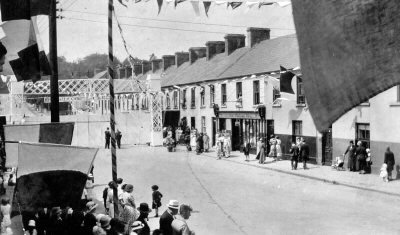
In those days, the wireless was the thing. If you possessed one, you were ‘well-off’ – or in our parlance, a swank!
The Mummers
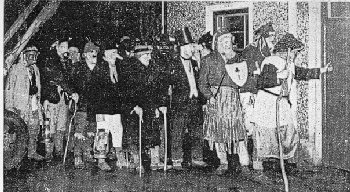
The poem of John Hewitt reproduced below is particularly poignant for me, because my mother remembers the Christmas Rhymers at Sheetrim in the very same time period, that is, c.1941, and the fictional, often historical characters they played out. There will be more on the Mummers, as they also were called, later, and the script of their dramas.
For now, enough to congratulate Pat Maginn of Bessbrook who revived the custom and has a Rhymers Group, and the Armagh Rhymers, who are excellent and whose costumes are highly impressive – perhaps just a little too polished! Hewitt called his poem
The Christmas Rhymers, Ballynure, 1941: an old woman remembers
The Christmas Rhymers came again last year,
wee boys with blackened faces at the door,
not like those strapping lads that would appear,
dressed for the mummers’ parts in times before,
to act the old play on the kitchen floor;
at warwork now or fighting overseas,
my neighbours sons; there’s hardly one of these
that will be coming back here any more.
I gave them coppers, bid them turn and go;
and as I watched that rueful regiment
head for the road, I felt that with them went
those songs we sang, the rhymes we used to know,
heartsore imagining the years without
The Doctor, Darkie and Wee Divil Doubt.
!
In case you’re labouring under the misconception that there is no Ulster-Scots culture or tradition, let me inform you that John Hewitt is right there, to the forefront, and one of my favourite poets!
Austin
The story of Henry Curran, shopkeeper King brought to mind my own recollection.
There never was, and I fear never again will be a shopkeeper the likes of
In the short time we knew him, we never learned his surname. It didn’t matter somehow. Like Elvis, he was fully defined by just the one name.
Santa’s Elves Outsourced!
EveryBank Ltd
Hill Street
NEWRY
16 October 2004
Hill Street
NEWRY
16 October 2004
Dear Valued Customer,
We have been requested by a valued client – and an acquaintance of yours, an esteemed old gentlemen who goes by the name of Mr Santa Claus – to make it generally known in the Newry area that, due to the current economic difficulties that he like everyone else is facing, he has recently had to move his industrial and administrative operations overseas.
Fortunately and co-incidentally for us, his industrial elves are now based in Bacca Beyon, The Keys, Dacca Peninsula, Punjab, where, you will recall, Everybank also has relocated. He has requested – and we are delighted to comply – that we now handle much of his administrative work in this region.
This letter is designed to remind you to advise your children, when writing their letter to Santa this year, to address it to
Mr Santa Claus, c/o Everybank Commercial Desk (Overseas Division), Taj Mahal Industrial Park, Bacca Beyon, The Keys, Dacca, Punjab.
Mr Claus regrets if this employment opportunity outsourcing causes distress to his former local employees. We would like to add our concerns but also to point out that if divine aid is applied for, our religious services desk is still operational. For a short period only, discount rates will apply to former employees.
Looking forward in anticipation to your continued support.
May your god go with you
Fatcat Prophets [Managing Director]
P.S. You will, I know, appreciate that Christianity is very much a minority religion in India, so Mr Claus’s new elfin workforce may not be able to meet artificial deadlines like 25 December – certainly not their saviour’s birth day. If children’s toys do not arrive until well into the New Year, we are confident you will show patience.
Civil ‘tinkers’
Sam Woods of Ballinalack was on his way home from Newry one time in his horse and cart when he came upon an old woman lying as dead in the middle of the road. It was Mary Kelly.
Some locals helped him to unhook a nearby barn door and she was carried into the home of the Savages and laid out in front of the kitchen stove. They managed to revive her and so prove she had not died. She was fed a little warm milk. Soon she was able to sit up at the table and eat a meal. After having warmed herself at the stove a while she refused all offers of a bed for the night and insisted she must ‘push on’.
Before she left she pressed a penny into the palm of the child of the house. With nods and frowns behind backs the child was warned to accept with grace. This was her way of retrieving her dignity and self-worth.
I was often as a youth called a tinker by adults and teachers alike, a term then denoting mischievous behaviour. But tinkers were travelling people who made a living by mending pots and pans.
Nailey Rice was really a tinker by trade. He still carried solder and a soldering iron. He was a very lean, old man who at one time had had a wife and a house but had lost one and left the other. People kept damaged buckets and pots against Nailey’s return.
He had a very loud voice and once distressed a feeble-minded old man of the house he was working at. The girl of the house cautioned him to lower his voice as ‘it annoys my father’s head’.
Nailey gave a lep into the middle of the road and bate the tin with the soldering iron!
‘What wud he do if there was thunder?’ he bellowed.
Gypsy woman called for alms to our doors in the Estates of the Sixties.
‘Missus, can ye spare a few coppers, for the love of God?’
They got a very mixed reception generally. I remember them as clean and well-spoken usually, if over-obsequious. They were always treated kindly at our home. But my mother was reared ‘in the country’!
This was back when their encampment was on the Fathom Road near Drumalane. A friend of mine who was their neighbour still speaks very highly of them. They just got ‘a bad press’.
Tom Kelly, Labour Champion
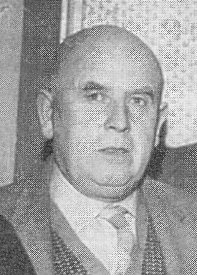
When the Irish Citizens Association won the day at the Council elections of 1949 – and continued to dominate local politics here over the next decade – the sole surviving Labour voice was that of Tom Kelly (pictured here). Single-handedly he championed at Council level the cause of the poor, deprived and oppressed of the town over that decade, because the populist green Tories led by Max Keogh and Joe Connellan were more interested in flag-flying and coat-trailing and self-advertisement in Keogh’s Frontier Sentinel.
The change began when Irish Labour won a clear-cut victory at the 1958 elections. Tom Kelly became chairman and enthusiastically led the social and housing reforms that were to quickly transform our town. The major house-building programme that had begun with The Meadow and Dromalane Estates was accelerated. Kelly, though a shy and quiet man, was an inspirational character and encouraged other Labour men of conviction and quality to follow his way. Thus after Tom’s retirement and early death we had leaders such as Tommy McGrath and Hugh Golding.
Tom Kelly was born in Newry in 1903 the only son of Michael and Margaret (Larkin). As a young man he was inspired by the writings and the life of James Connolly and he was a volunteer in the War of Independence. He was arrested by the Black and Tans along the railway line in Newry on 23 May 1921 and suffered a severe beating which left him with a lifelong hearing defect. He was sentenced to 15 years for possession of firearms but later benefited from a general amnesty.
In jail the contemplative life inspired his faith and on his release he in 1924 joined the Jesuits. His six years in the order strengthened his faith again and his conviction that peace and justice must be pursued through non-violent means.
Working as a carpenter in Dublin he often returned to Newry and on one such visit he met Sarah O’Gorman of Damolly whom he would later marry. The new Mrs Kelly wanted to live in Newry and on his return Tom gained occasional employment at the Docks in Newry, Warrenpoint and Belfast. In Newry they lived first in High Street and then, for the next thirty years at Rooney’s Terrace.
Through all these years Tom worked on behalf of the working class, helping to fill out claimant forms, for example, for the unemployed who needed such help, fighting tribunals for the redundant and championing the cause of the poor. He became a regional representative of the Woodworkers Union and took an active part in the wider Trades Union movement. It was not till he heard an address at Newry Town Hall in 1943 by the famous Jack Beattie of Belfast that he joined the Labour movement.
When the Labour Party split at the end of that decade over the declaration of the Irish Republic, Tom held fast to his convictions and remained with the Irish Labour Party. Thus it was that he was elected as the only Labour man to the Ballybot ward in that year’s elections. Among those who canvassed for Tom was Turlough O’Donnell, son of the well-known Labour activist and who himself would rise to become High Court Judge of Northern Ireland. (When last I heard, Turlough, an interesting and obviously very articulate man, was living in retirement in Blackrock).
For the next ten years, though the ICA blocked his membership of key committees at every turn, Kelly’s reputation as working-class hero only grew and he topped the poll at a number of subsequent elections. He championed the use of a merit points system for the allocation of houses before any party adopted this as policy. He opposed the building of further sub-standard ‘orlit’ homes and called for the total removal of slum housing. The Labour Party, and Kelly in particular suffered from the breaking of a ‘gentleman’s agreement’ in 1955 that saw the rise and election of Joe Connellan to the South Down parliamentary seat and deprived our people of the voice for social justice we deserved on that wider stage.
The election of 1958 saw Tom Kelly become Chairman of the Urban Council and Newry’s first citizen. A bitter split in the ranks in 1962 affected Tom’s already poor health. Despite the onset of Parkinson’s Disease he contested a final election in 1964. He remained Chairman of the local Irish Labour Branch and saw it successfully reassert itself against Tommy Markey’s dissident Newry Labour.
Despite a stroke he attended the famous first Civil Rights Marches in Newry. On 12 April 1969 at age 65 Tom Kelly died. A member of the National Graves Association contributed a tricolour to his widow to adorn the coffin, in tribute to his lifelong patriotism. Stephen Ruddy, an Irish Labour colleague brought a Starry Plough. This became the flag of preferment for a man who had dedicated such a large part of his life to the Labour movement.
May this working-class hero long be remembered.