Canal towpath: final account

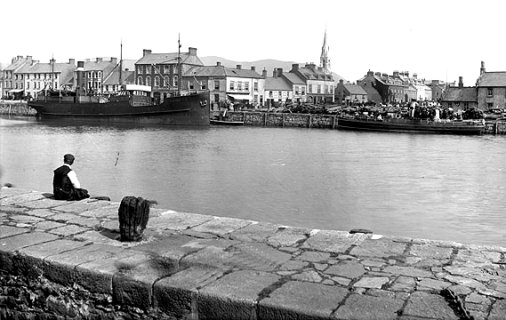
boatbarrack.jpg

After the building and opening of the Ulster Farmers Bacon Factory sometime in the late fifties the canal and also the Bessbrook River became quite polluted and fell out of favour as a swimming spot.


The Bacon Factory was not supposed to discharge waste to the canal – and actually they didn’t – they simply discharged into the Bessbrook River – which just happens to flow into the canal, thereby polluting both waterways at one stroke. 


The County River though remained clear of the factory’s polluted discharges because of the wall that separated it from the canal. It still remained a popular place of aquatic delight right up until the opening of the Newry Swimming Pool in the late sixties. 


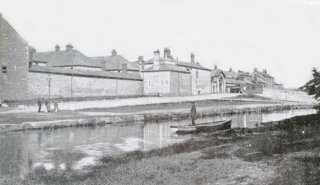
The Towpath and canal have again changed their aspect,  compared even to my childhood reminiscences earlier. The Towpath itself has been tarmac-covered along its entire length; this makes it a lot easier for cyclists to navigate.  Some of the locks have been cleared and the lock gates restored.


The old lockkeepers’ cottages at the first three locations, Riley’s, Fearons’s and McKnight’s locks, have all been demolished lending a sad and lonely appearance to the whole place.  The ubiquitous hens have all gone and have been replaced by the usual anti-social element of under-age drinkers and feral children. 


The recent new construction work carried out at St. Coleman’s College, towers above the old towpath and dominates it. The result is not at all in keeping with the air of tranquillity that used to prevail at this location. It would have been much better to have kept the little copse of trees that this monstrosity replaced.


The greatest changes to have taken place in the towpath area though must surely be at the place we used to call ‘the track’.  The little bridge is still there, as is the canal and also the Bessbrook River, but the County River has been subject to a huge diversion.  The river has been straightened up removing that long curving bend that used to swing the river around to meet with the canal and outlet leading to Damolly Mill.


This huge area that used to encompass the river itself, Sandy Bottom, and a lot of the old Damolly Mill grounds is now the (unused) lorry park of the disused Customs Road Vehicle Examination Station.


The joyful cries of delight from the kids who used to use this area for swimming have been replaced by the throaty roar of the traffic passing over the Newry bypass flyover that straddles the towpath a hundred yards or so further on, beyond ‘the track’ …


Is this what we call progress?


… Dick’s Ashtray ? …


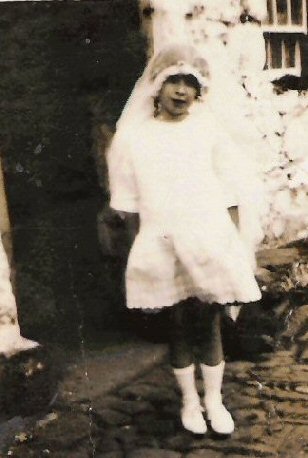
…  end : Baby Bernadette ?…
Pitch and Toss

In the middle part of the last century there was many a pitch-and-toss school in and around Newry. The one I remember most was the one in Dromalane Park. It usually started after 10.30 Mass down at the football pitch.

There were first the ‘looker-outers,’ usually young boys who had a ball and looked out for the police.  If they were seen then the shout went up and the members of the ‘toss school’ took up playing football. The boys had it down to fine art and I don’t remember anyone getting caught by the police at the toss.

Then there were the ‘stookies’.  They were in charge of the money of the person tossing the half-pennies.  It was their job to get as much as possible on for the person tossing the two coins who had to ‘head’ the half-pennies.

The call might go up ‘heads two shillings’ or whatever and if one was betting on him not to head the coins, then the reply was ‘harps your two shillings’ or what ever part of it you liked.  If he headed the coins then he collected the money and stayed ‘in’ until he harped the coins. The ‘stookie’ would get a few bob from the player if he won.  

The stookie would then start into playing the toss so the money went round. It was never ‘heads’ or ‘tails’ by the way it was always ‘heads’ or ‘harps’. 

It was pretty hard to cheat at the toss but people were sometimes found to have a two headed half-penny but woe betide the person caught with one.  To make sure that all was above board the ‘harps’ side had to be up front so that the punters could see them.  Many a wage was lost at a toss and many a person went away with quite a bit of money. This is one such story. 

One Sunday at about 1.30pm the toss was going well when a gentleman, who was on his way home from certain club for his dinner, stopped at the toss.  The call went up: ‘ Heads a pound’ and the said gentleman said,  ‘I’ll cover that.’ He duly did, and went on to cover any other bet with any one who would take his money.  The player harped the coins and lost. The gentleman won his money and continued to back ‘harps’ for about twenty minutes and won every time.  He then bid everyone good day and went home leaving the school nearly broke.

The next two Sundays he proceeded to do the same and again broke the school.  On the forth Sunday things changed. The looker-outers were told to forget the police and watch out for a certain gentleman.  The shout went up, ‘Here he comes!’

Cross Blacksmiths

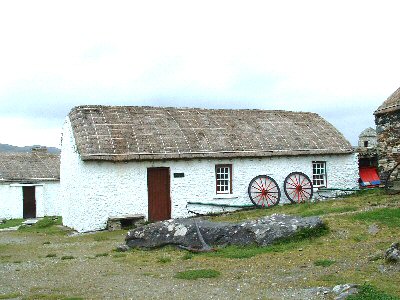
CottageCartwheels.jpg

There were few tractors in the 1940s and early 1950s and horses did most of the work.  There were many blacksmiths in the area; at Creggan, a mile down the road, Jack McKeown at Sheetrim, Cullyhanna, in Crossmaglen on the Monug Road, one at Ford’s Cross near Silverbridge, and my Uncle Mickey Boyle’s at Legmoylan, just off the Newtownhamilton/Dundalk Road.  


I was fascinated by the smiths and by the sounds and smells of the forges (smithies); the dark interior, the dull glowing fire on a plinth which flared to white hot when powered by a large long handled bellows, the sweating muscular blacksmith creating a horseshoe from a bar of metal by repeated heating and hammering on the anvil, the sparks from the fire and from the metal being hammered flying up and fading, the red light of the fading fire reflecting from the sooty sweat on the smith’s arms and face.  


Each smith had his own rhythm on the anvil, a pattern of allowing the hammer to bounce on the metal before smiting the iron being shaped.  The rhythm would repeat until the metal was too cool to shape – at which point it was returned to the fire and the bellows applied until it was again glowing red.  At various points the hot shoe would be applied to the horse’s hoof, to check for size and to provide a snug fit for the final product.  The smoke from this and the acrid smell of burning hoof filled the smithy.


I was constantly amazed that the horses seemed unconcerned by this apparently cruel process.


… more later …