There was a programme on Radio
During the Second World War some Divisions of the American Army were stationed in Bessbrook prior to their departure to
‘ Sir, what can I get you?’
Newry News and Irish Fun
 John McCullagh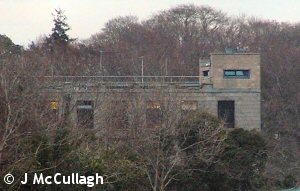
There was a programme on Radio
During the Second World War some Divisions of the American Army were stationed in Bessbrook prior to their departure to
‘ Sir, what can I get you?’

As I walked down the busy footpath with my wife, knowing I was late for Mass, my eye fell upon one of those unfortunate, ragged creatures that are found in every city these days.
Some people turned to stare.
Others quickly looked away as if the sight would somehow contaminate them.
Recalling my old priest, Father O’Toole, who always admonished me to “care for the afflicted, visit the sick, feed the hungry and clothe the naked,” I was moved by some powerful inner urge to reach out to this unfortunate person.
Wearing what can only be described as rags, carrying her treasured worldly possessions in two plastic bags, my heart was touched by this person’s condition.
Yes, where some people saw only rags, I saw a true, hidden beauty.
A small voice inside my head called out, “Reach out, reach out and touch this person!”
My kindly intervention was violently rejected.
Indeed, to my shame, my wife of forty years joined the attack!
I won’t be at Mass next week.

Indeed, I am now alone in the world.
Would you visit the sick ?
Please ?
Tonight is the big one, the performance we have all been waiting for, the appearance of the home side Newpoint, presenting Friel’s Dancing at Lughnasa. It is the welcome return as director of Sean Treanor and as actors of the fabulous team of Patricia McCoy, Pauline Lynch, Denise Taylor, Paul McParland, Pat Mooney and Laurie Hodgett and the debut of Corrina Cunningham and Molly Finn.
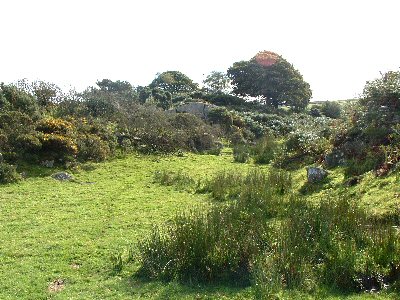
Discipline in the family was down to mother. I can recall only one occasion when my father punished me. I was swinging an old bicycle pump round my head in the street…
Hag old, depraved woman; to chop or cut
Hagging-block where meat is chopped
Haggard stack yard
Hake rob an orchard
Hallion abusive term for unattractive person, usually woman
Hanch snap
At Hand close by
A hand’s turn the smallest item of work
To my hand convenient
A bad hand at unskilled
Hamsel first use of anything
Haveral coarse, silly
Hap to cover or clothe
Well-happed well clad
Happed with a spade buried
HARD hardy morning frosty morning
Hard of hearing deaf
Hard man difficult/close-fisted/paramilitary
Hard tack strong drink
Hard hat bowler hat, by extension an Orangeman
Hard word negative assessment
Hard-used badly-used
Hairy[harey] cunning, evasive tactics, like a hare: scary a hairy experience
Harl a lump
Harn harden
Harem-scarem wild
Hash slash
Hate 1. quantity ‘put a hate o’ salt in the broth’
2. bit ‘divil a hate I care’
3. ‘not a hate to his story’, it’s untrue
4. heat, ‘the birds’ tongues were hangin’ out wi’ the hate’
Head 1. headway, ‘making no head with his lessons’
2. ‘not a word out o’ yer head!’, be silent
3. ‘he’d ate yer head off’, he would shout loud at you
4. ‘over the head of’, because, i.e. ‘it’s all over the head of you’
5. ‘good heads’, clever people
Head-rig ridge where the plough-horse turns
Heart-scalded very seriously troubled by
Hear-tell I heard it said, ‘I hear-tell he’s for moving’
Heartening encouragement, ‘a sunny day’s a heartenin’ in the hay field’
Heartsome cheerful
Heavy charge weighty burden
Heavy-han’-ful troublesome, ‘the boy’s a heavy-han’-ful’
Heavy on the leather walks unevenly, wears out shoes frequently
Heavy-headed stupid
Heavy-handed footery, physically inept
Hector bully [also well-loved 60s Newry market-trader!]
Hedge conceal, dodge, ‘he can hedge, all right!’
Heel-in place plant temporarily in the soil
A light heel a good dancer
Heel upend a cart
Heel-end the very end, ‘at the heel-end of the evening’
Heels foremost as corpse carried from house, ‘he won’t budge again until he’ll go out heels-foremost’
Het heat, pickle, ‘he was in a great het over it’
Helter-skelter disorder
Hinch thigh
Hilt-nor-hare sign nor light, ‘I saw neither hilt nor hare o’ them’
Himself [as in ‘not’] ‘he’s not himself at all’, he’s feeling unwell
Himself [ as in ‘full of’] ‘he’s full of himself’, conceited
Hipple limp
Hirple to walk with difficulty
Hit catch, ‘unless he puts his best fut for’ard he’ll not hit the bus’
Hobble trouble, ‘she’s in a quare hobble’
Hoke to hollow out, excavate, search for, ‘hoke it out, will ye?’
Holm sheltered land
Home grave, as in ‘the long home’
Horn to gore, ‘the cow horned the wee calf’
Hot-foot go speedily
Houghle move awkwardly
Hoult hold, grip, catch ‘take a good hoult of it there!’
Hudders top sheaves of a stook, ‘put the hudders on the stook’, i.e. draw your story to a close
Hugger-muggery shameful or secret conduct
Hunker crouch
Hunker-slider untrustworthy person
Hurry usu. in the negative, ‘shure there’s no hurry’ or ‘take yer hurry in your hand’
Hursel bronchial-sounding, ‘he had a hursel in he’s throat’
Hut hit, ‘he hut me first, he did!’
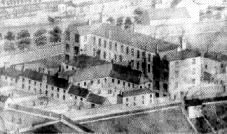
This poem which was passed to us by Martin Toal was written in 1998 by Jim McParland, and was delivered by him at a 50th celebration of the National Health Service.
That celebration was held at the Mourne Country Hotel. Present were a number of people who were employed in the old Workhouse – and some who remained on the staff in that building after its integration into the NHS.
Jim McParland was one such. He wrote the following poem about his memories.
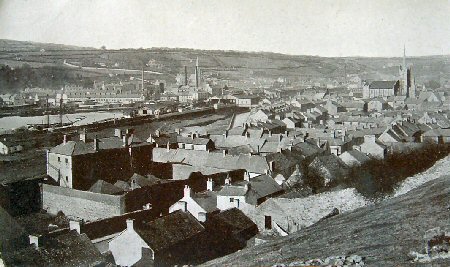
A scribe of recent yesteryear reflected on Newry of old, in the form of scenes from an imaginary walk through our fair streets then. I consider his musings worth repeating.
‘Let us first, in the company of a group of other wanton boys recently released from the stern discipline of Brother Dempsey at the Carstands School, disport in the waters of The Rampart. We wander through Pighall Loanan and over the Bishop’s Hill, vying with one another as to who will first dive into ‘Track Line’.
On the Downshire Road a bazaar for the benefit of local churches is being held. There are contests in music, drawing and many domestic arts. There is, particularly a Flute Band Contest with entries from Belfast and other towns. Michael Magill conducts St Joseph’s Band with Terence Ruddy and John Loy distinguishing themselves as instrumentalists.
A solemn procession leaves Dromalane House and passes along Dromalane Road, through Bridge Street and High Street to Meeting House Green, commemorating the funeral, a decade ago of the patriot John Mitchel. His widow Jenny Verner Mitchel, is just recently deceased in New York.
The mud heaps in Doyle’s Field have been levelled, grass sown and a road cut through its centre, for the Lord Lieutenant is soon to open an exhibition in the Needham Street Market. He will arrive by Edward Street railway station and we must clean up the ‘front door step’.
It’s Regatta Day in Newry. The Middle Bank is thronged with visitors and a goodly crowd is enjoying sports day in Greenbank. In the track event a bicycle race is about to start. The local riders, Dierson, McKnight, Graham and others, resplendent on their high velocipedes, are lined up when the appearance of a new entrant on a contraption with both wheels the same height, creates a laugh! Amid the general mirth a few strangers are circulating the crowd offering wagers that the Dublin stranger will win. The sporting elements among the townsfolk take the bets. It was Newry’s first sighting of a safety bike and the strangers reaped a rich harvest as it easily won. The local sports are sadder and wiser.
I pass, with some difficulty, through Monaghan Street. Both sides of the street, from Lamb’s Corner on the west to Magill’s Corner on the east, are lined with wagons that are full with groceries from the shops of McKnight and Renshaw and Dromgoole, and from Dickson’s provision store, adjoining ‘The Chestnuts’. The farmers standing in groups on the footpaths are jostled by laughing and carefree workers on their way to dinner from Dempster’s Mill, Wilson’s Mill, the Newry Foundry in Edward Street and Lupton’s Mill and Henry’s Brewery in Queen Street.
Coming to the Godfrey Bridge I stand and look north towards Sugar Island. A vessel opposite Beatty’s mill is discharging a cargo of Indian corn. A lighter is being loaded, further down, at the Salt Works, between the canal and the tidal river. Opposite Edward Street a vessel is discharging wheat for Felix O’Hagan’s Mill at the junction of Catherine Street and Edward Street. A little to the south a lighter is supplying coal to the yards of Mr Greer. Further north still, identifiable only by the familiar but distant sounds, another vessel is pouring out its load of golden wheat to be ground into flour in the fine brick mill of Mr Sinclair.
And now I turn south and look towards the Ballybot Bridge and the Buttercrane Quay. The scene is one of even greater activity. Opposite the premises of Carvill and Company, one of their own fleet of vessels is discharging a cargo of lumber, hewn in its own forests in the New World. The roadway along the canal is strewn with slate, sand, cement, and with steel for the manufacture of spades and shovels; wagons awaiting entrance to the yards are lined up as far as Magill’s Corner. Redmond and Company has a similar scene outside.
I walk south along the Quay. Again I am impeded by the milling crowds intent on purchase, and by mill hands from Dempsters and Wilsons, with those from the weaving factory on the Dublin Bridge and the Dromalane Spinning Mill, all returning for the afternoon’s work. My ears are dinned from the clang of iron and steel fabrication from Lucas’s Foundry on the opposite bank. Near the Dublin Bridge an overhead crane dips its steel buckets into the wheat-filled hold of a steamer and carries it aloft, across the street and into the maw of Fennel’s Mill. Another vessel is doing the same for Walker’s Mill in Mill Street – one of the first establishments of Europe, it is said, to have electric light of its own generating.
I cross the Bridge and come to Albert Basin and the sheds of the Dundalk and Newry Steampacket Company. A steamship lying at the wharf is taking on, by means of a gang of busy quay porters, a miscellaneous cargo with which the bulkhead and sheds are plied. There are slabs of granite and paving blocks, hewn from the Newry quarries that are destined to build the mansions and pave the streets of England; raw hides; finished leather from the many Newry tanneries; distilled spirits in cask, keg and bottle, from the warehouses of Matt D’Arcy and Company and Henry Thompson and Company; crated fowl and livestock for the Liverpool Market; bales of linen and linen yarn and other commodities manufactured in and near the town.
Further down the Basin, Spanish sailors, ear-ringed and swarthy, are swabbing decks of a barque that has brought sherry grapes from Malaga and other Iberian delicacies for McBlain and Company, Martin, Nesbit and Irwin, Kinnear and Lang, the Golden Teapot and The Golden Cannister.
Leaving the Basin and walking through William Street and up Hill Street – passing on the way the coach factories of Bannon and of Lawson – and then through Margaret Street and North Street, I find the same state of active business that was presented elsewhere. ‘
Newry was then a busy and thriving town, and mainly a manufacturing town.
During the 18th century in Creggan, and throughout