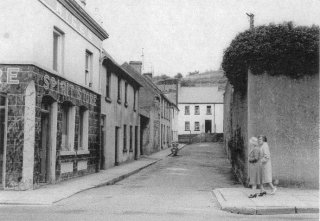
In those difficult War Years, it was the young married couples with small children that got it hardest to survive.
 John McCullagh
2007 Drama Festival begins
Newry Drama Festival is now well under way and it’s time I brought you up to date.
Labour in Newry: 1: Larkin/Fearon
Newry was still at the height of its commercial and industrial power towards the close of the nineteenth century when workers’ unionisation became an issue. The concentration of manufacturing in industrial cities had not yet stripped the smaller towns of such enterprises as brewing, distilling and baking. One of the bakery moguls, Willis of Monaghan Street in 1896 locked out his employees who were agitating for a fair wage and decent working conditions. There was no shortage of volunteer blackleg workers from out of town willing to fill their shoes. To the eternal shame of the present writer, it must be acknowledged that by this route did his grandfather first arrive in Newry about that time! Newry was one of the first Irish towns to have a Trades Council. In 1890 it had a membership of 280 and seven affiliated unions. In the same year branches of the National Union of Dock Labourers and the National Amalgamated Union of Labourers were set up here.
Further evidence of the reactionary attitude of employers came in 1904 when Wilson’s Mill Ltd. in Cecil Street locked out some 270 workers rather than negotiate a dispute over wages. But it was the docks that became the greatest centre for agitation since almost all goods passed through and the owners ruthlessly exploited the plight of dock workers desperate for even casual work to feed their families. The son of a local exile, James Larkin did most to organize the dock labourers first in his native Glasgow, but in quick succession the other major British ports and then Belfast, Dublin, Newry and the other Irish ports of entry. Newry Dock Labourers joined their Belfast comrades in the 1907 strike. John Gray of the Linenhall Library rightly points out that this action called for courage on their part where they were in defiance not of Protestant and British vested interests as in Belfast but Catholic businessmen and indeed Catholic Church representatives. The local leader was James Fearon, elsewhere extolled on Newry Journal. Bill McCambley asserts that ‘behind the back of Fearon and the Union, the Catholic Bishop Dr O’Neill and others cobbled together a draft agreement and presented it to the dockers who, because of its origin, signed it, despite the contrary advice of Fearon who indicated that it upheld the absolute right of the employers to hire whomever they wished and obliged men to discharge all boats unconditionally.
(Labour in Newry: 1 of series of 8)
Bridgit’s monasteries
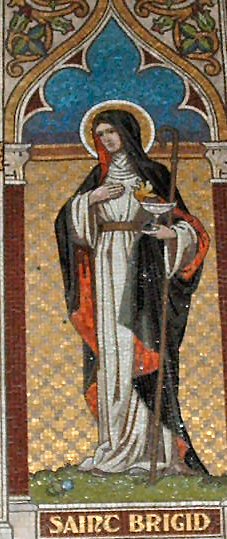
When she was of marriageable age her father tried to arrange a marriage for her, but Brigit refused all suitors, being determined to become a nun.
Francis Carroll, Bishop of Monrovia
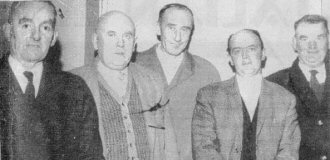
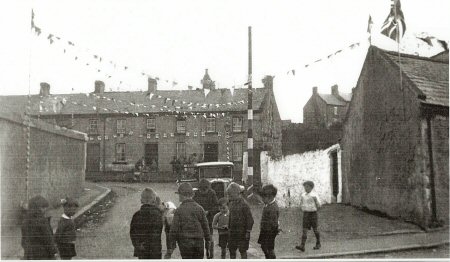
This old photo shows the elect of the town in the early 60s celebrating the elevation to the Bishopric of Monrovia of Newry’s Castle Street man Francis Carroll. A list of names will follow!
November reviewed
I haven’t laughed as much in ages! Indeed, owning a hearty guffaw, I could be heard all over the auditorium, to the consternation of my dear wife and companion. But ‘November’ was absolutely hilarious!
Skipping song – incomplete
Can anybody complete/correct the following skipping rhyme that’s running through my head ?
Knickers’ pockets
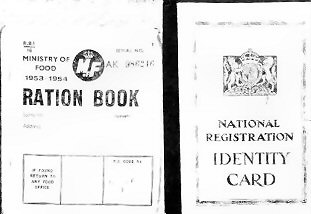
As well as ration books for food and fruit, households were issued with clothing and sweet coupons. Because of the shortage of material and the need for coupons, it was not unusual to have old garments unpicked and remade into other clothes for children.
I had one such garment, a brown serge suit trimmed with mustard which had been an old coat belonging to one of my aunts. Woollen garments were also unpicked, the wool washed and a new garment then re-knitted.
John Torley
Jack the Hunt was the more common name for the acclaimed John Torley whose encounter with the Newry Board of Guardians can now be revealed under the 100 year rule!
Outdoor relief had now become the norm and Torley made personal application. Indeed in anticipation of some revelry – for his reputation had preceded him – he was given permission to plead his case before the monthly meeting.
He wanted, he said, some compensation in order to get a pair of ‘relievers’ (laughter) to comfort him in the pursuit of his avocations among the ancient aristocracy in his representative capacity, which as they all knew, was associated with the Newry Harriers (Hunt!) (more laughter).
He hoped with greatest sublimity (laughter) that the honourable members of the Board in their sagacity (laughter) coupled with their renowned benevolence (laughter) would do him that one favour and thereby maintain the reputation of that co-habitable institution (loud laughter).
Chairman: What is it you want?
Jack the Hunt: Something to help aid and assist, comfort and otherwise sustain my feet in this amphibious weather! (laughter)
Chairman: A pair of boots?
Torley: Please.
Mr P O’Hare: Long or short ones?
Mr Toman: A pair of hunting ones?
Torley: Bravo, Mr Toman! (laughter)
The Chairman said that he was afraid that he could not legally entertain the application. Mr Murtagh proposed that they ”send round the hat’among those present. Mr Cardwell did just that and raised the sum of 17 shillings and 6 pence. This was handed over to the Clerk with the request that he should purchase the required articles for the applicant.