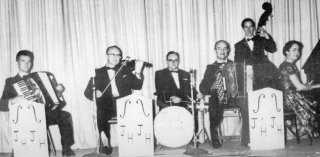
Showbands: We experienced the pleasure of live music from visiting bands at our dances and ceidhles. They would all be fronted by a vocalist and dancers would send up pieces of paper with song requests written on them.
Dance Bands…
Newry News and Irish Fun
 John McCullagh
Showbands: We experienced the pleasure of live music from visiting bands at our dances and ceidhles. They would all be fronted by a vocalist and dancers would send up pieces of paper with song requests written on them.
The Lamplighter: In my childhood the street lighting was supplied by gas. Men were employed to carry a long pole with a small hook on the end, and a wick to be lighted, from lampstand to lampstand. They returned at dawn to extinguish them. Since they had to be up and about at this time, their services were often utilised by the like of factory workers, to wake them up by knocking on doors or tapping on windows. The last lamps in operation were in the South Ward. Does anyone remember them?
I also have fond memories of ..
Having recently been made aware of your website, I would like to share with your contributors/readers recollections of two of my Aunts; these were sisters of my Mother and part of the McCann dynasty from Newry’s most famous “arrondisement” of
Thrush: infection of the throat
Tick: credit, ‘most of our goods are got on tick’
Tied: outraged, ‘fit to be tied’
helpless, ‘we laughed that much we were fit to be tied’
confused, ‘you’ve got me tied up in a knot’
As a border town Newry was able to offset the worst effects of rationing. This was accomplished by trips to the shops across the border or bus trips to
I have fond memories of
The Turning bridges: there were five such on the town section of the canal: at Sugar Island; Monaghan Street; Ballybot; and Buttercrane, where the rail crossed the canal; and Dublin Bridge. This was to allow barge traffic bound for Portadown. A bell would sound in the Harbour Master’s Office to alert people. School children used the cry, ‘The bridges were closed!’ as an excuse for their lack of punctuality.
Bob Brown turned the key in the latch of his front door, gripped the lion’s-head knocker and pushed the door firmly to make sure it was locked. He felt a strong tickle in the top of his nose and reached into his overcoat pocket for his big Irish linen handkerchief. He sneezed into it violently. A few seconds later he blew into the hankie, wiped it back and forward under his nose, feeling wetness on his upper lip. He coughed into the hankie several times and looked into it to check for blood but there was none. He crumpled the cloth and stuffed it back into his pocket. Across the road, the herring-man clicked his tongue loudly to start his horse up the hill. He looked across at Bob but offered no greeting. Bob wasn’t too concerned about that. The man was one of the herring-chokers from Rosmoyle, and they were a queer lot. Most of them didn’t like Catholics but it didn’t stop them taking Catholic money. Bob was
The Newry General Holiday was held in the past in September and the various transport services ran cheap excursions to other towns and cities. One of the most popular was the Great Northern Railway Special to