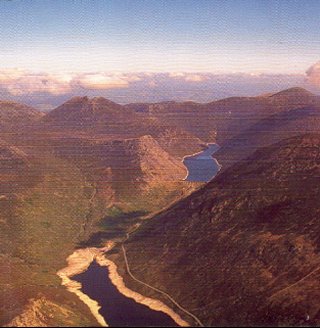
This working quarry near Hilltown is interesting for a variety of reasons. It contains a unique seam of rock that is currently very valuable in many aspects of the building industry. Its rock is blocky, hard, sharp and slightly flinty in texture. The homogenous blocks are contrasted with, for example, the fissilated [wafer-like] shales more common to the region. Its grain size is smaller than the average. It is under the ownership and excellent management of P Fitzpatrick Quarries who are fully aware of the valuable resource and practice good environmental control.
 John McCullagh
Digging Boats
It was rough on those coal boats. They worked with tubs. There was a derrick on two masts. A man drove it with a winch. There were four tubs in the hatch all the time. And one in the air all the time. Two men per tub were constantly shovelling. When the hook appeared the tub was taken, full or not. At times it was overfilled and a man would often be struck by a falling coal. He was slung in the back of a cart and taken to Daisy Hill. My dad left home at 2 am to walk to Newry. Or 12 to start at one. The tides dictated the times of the boats’ docking. At times the work was done by oil-light. You had to buy your own shovel. You had to give 1.5d per tub for the wear and tear of your gear. You had seven hours to empty the boat to have her ready for the next tide.
How much might you earn? Well, from one boat, with one hatch, a Thin Lizzie, about 6/6. You’d check the newspaper for the tides. There was work for carters as well. [Men with horse and cart in which to ferry the coal]. They might go as far as Cross or Newtown with a load of coal. Much went to the gasworks. It was a common sight to see women with shawls around them wait at corners to gather coals that might fall off there. It was not unknown for the carter to drop some deliberately. And occasionally these generous souls would be seen and reported by Fisher’s men. Charges would follow. Kevin remembered one magistrate’s comment:
‘What would you expect? Wasn’t his father a thief too?’
If you got yourself ‘blacklisted’, you were done for altogether. Then there were grain boats, and when they were emptied they’d have to be swept out to make them ready for the next cargo. Young lads would ask for the sweepings for their pigeons. He’d have to avoid the harbour constable who frowned on this practice.
The sailors who worked the boats had a hard life too. They were forever racing tides and working through their holidays. They’d even work Christmas Day, for it wasn’t then observed in Scotland, for example, that preferred Hogmanay. Paddy O’Keefe worked on the Rowan. Away from home and paid on a Thursday, they’d wire the money home to the womenfolk who’d get it on a Saturday, desperate for it. Bosses liked to humiliate their workers, teasing and humiliating staff before handing it over.
Finally, from Kevin, a few miscellaneous comments. The people then still have a few odd words in the Irish language. His father remembered the building of Cloghogue Chapel in the twenties. It was Neery, a lawyer that built it. He went broke building the Parochial House attached.
A Kerryman, married to his cousin, couldn’t believe the
Dome of Slieve Gullion
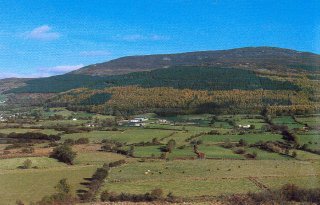
Dome of Slieve Gullion
And of your brood
My soul is apart
In your rock-heather heart
Slave to your mood.
Mystical beauty
Breathes on your brow
Sun-setting beams
Lull me to dreams
Far from my plough.
Wild inspiration
Flees unexpressed
Through tinted sun-trap
Ancient mist wool-cap
Stirring my breast.
Mountain of mystery
Of Fionn the brave
Of Saint-scholared Gael
Of legend and tale
I am your slave.
Michael J Murphy
Travelling Woman
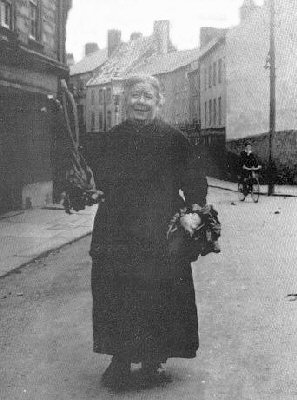
Have you noticed the absence of street ‘characters’ over recent decades? If it wasn’t for Bearded Marty, ever present at all hours of the day and night, we’d have totally lost all ‘local colour’ – as my schoolmaster used to put it! Stop and chat with him some time – he’s got an interesting life style and a good line in craic.
Voices & The Sound of Drums
I know nothing at all about the book I’m about to ‘review’ except that it was entitled ‘Voices and the Sound of Drums’ and it was written by Patrick Shea and published in 1981 by Blackstaff.
I came across this short excerpt and was mightily impressed. I’ll really have to make an effort to locate it (Amazon, again!) and buy a copy. I hope you conclude likewise.
During our lunch period I walked along North Street, a tumbledown part of old Newry, to the Butter Market and found myself in the midst of a hiring fair; a fair in which the merchandise was human beings. Those doing business were standing about in small groups, talking quietly; a sturdy man holding out for what he thought he was worth as a ploughman, a rosy-cheeked servant girl listening and nodding as details of the offered engagement were explained to her by a farmer and his wife, a mother handing over her fourteen-year-old son on the understanding that in return for his apprentice labour on a farm he would be kept and given three meals a day and after six months she would be paid perhaps five or six pounds.
Hiring fairs were peculiar to the northern part of Ireland.
Do any of you know this book? Was Patrick Shea a relative of Jack, our Laughing Policeman of Derrybeg Lane? And of Dorothy (Dodo to us rude and uncouth schoolboys, although I remember this dear and unassuming teacher taking us for amateur drama practice in the living room of her own home in Derrybeg Lane on Saturday afternoons, for no reward!). Gone now to her eternal reward, it’s too late to tell her how much I appreciated her.
[Yes I know the latter two were brother and sister, and were O’Shea – but that doesn’t exclude the possibility of some familial relationship with the author!]
P.S. I’ve just received an e-mail from Peter, the son of the author of this book. He lives now in Australia but is visiting us in May. And YES, Jack and Dorothy were brother and sister to Patrick.
I’d love to meet him then. Perhaps he will loan me a copy of the book, so I can do a proper review!)
Creggan Parish 1840s
Writing c.1840 as the incumbent of the Parish of Creggan (Protestant), the Rev Simon Nelson gives a remarkable insight into the ‘customs, manners, popular superstitions and amusements of the inhabitants’.
The Art of Storytelling
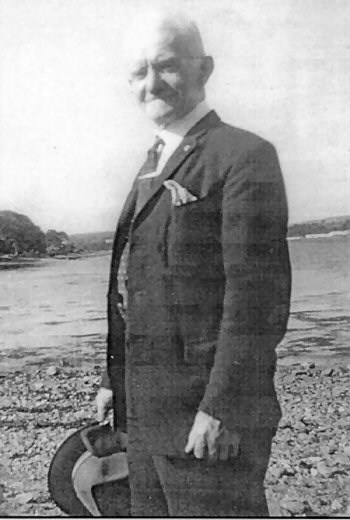
The storyteller’s art is a dying skill. There was until recently (there may be still, for all I know) a Newry Storytellers Group. I am a fan of the old style. My uncle was a storyteller from Sheetrim, as was his father and grandfather before. The custom belonged by the fireside of the old-style ceili house where neighbours gathered of an evening to while away the long winters’ nights. The only surviving such home that I know of is that of my dear friend Sarah Hagan, extolled elsewhere in these pages. I know of a few survivors of the storytelling genre, most notably John Campbell of Mullaghbawn [and his mate, Len Graham, and their friend Mickel Quinn]. Terry Conlon tells the odd yarn at the Thursday night Railway Bar session. Jack Lynch of Cavan is good too and there are others. In Rostrevor of a Wednesday evening (8.30 – 10.30 Rostrevor Inn, we have Alfie Corr, Kathleen Lucas and Dominic Bennett. The one I am about to tell belongs to Jack.
Perhaps the first requirement is the accent. I am hopeless for I’ve been cursed with a town accent that is totally unsuitable! Worse, I cannot assume any other accent. To my ear, it has to be a broad South Armagh lilt, or at worst, Midlands or West. The far South (Cork/Kerry) is probably good too, but no one can understand them but themselves. They must have the rare laughs at everyone else’s expense!
It helps enormously to have a seasoned, world-tired face (sorry, Terry!) with a permanent comical expression. Only the twinkling eyes can betray the teller’s real message. One must not laugh at one’s own jokes! The art probably developed as a defence against the jibes of the foreigner who loves to assume abject ignorance in all natives. The storyteller plays the assumed part with practised finesse. The foreigner, confirmed in his prejudices, departs, feeling totally vindicated with his jaundiced opinions. Behind him, everyone is roaring at his gullibility.
Many stories tell of the helpless traveller, normally a real amadan, who was a common enough figure in Ireland of previous centuries. Jamesy, the uncle, told of one such. He was cursed with an inability to properly express his emotions and constantly said the wrong thing!
He was walking the Bog Road one day when he came upon two men stuck fast in the bog hole. He roared and laughed and merrily wished them Good Day, as he had previously been advised. One man escaped from the quandary, came over and loudly scolded him for his intemperance.
‘What should I say?’ asked the amadan.
‘You should say ‘The one’s out, may the other soon be out”, he was chided.
Of course, the next poor man the amadan met on his travels had suffered a serious accident, where one of his eyes was totally removed from his head.
‘The one’s out, may the other soon be out!’ he roared gleefully.
In the story, these scenes repeat for up to twenty minutes telling. The simplicity of the twists is an essential device. The art is in the telling, and frankly, one should never commit to written words such a unique art form. I was recently given a book of Old Irish Songs, without the music. I can sing those I know. The rest read like insufferably bad poetry. Think of The Meeting of the Waters without that beautiful air. Despite this warning to myself, I am about to proceed. My justification is that there are hundreds of exiles out there who have never, and will never hear them being told as they should be. Please imagine the slow, heavily accented telling, the heavy pauses between phrases [if I wrote these in, it would spoil the imaginings] the twinkling eyes, the build-up, the throwaway punch lines, the look of bewilderment on the teller’s face that people should see the funny side of a very serious situation!
You might have heard it said by some that the South Armagh people are a bit mane – a bit tight, as they say here – but there’s not an ounce of truth in that: not a single ounce at all! – In general, that is.
In fact the only mane man I ever knew from that area was P J Brannigan from the parish of Sheetrim, in the townland of Creggan, near the village of Cullyhanna. A few miles from Crossmaglen. Have I got you located yit?
Anyway I called to visit his house wan Sunday mornin’ and wasn’t P J watching the mass on the television. And what am I going to tell ye only, when it came to the Collection time, didn’t he turn the television aff?
Another time I called hoping for a bit of a feed – seeing it was about lunch time. The mother was within, but P J was without. Out standing in his own field. Acting the scarecrow. He looked the part. He had bits of straw stuffed up his sleeves and up his trouser legs.
But he had to come in to lunch, and that’s when the crows had a bit of a feed to themselves too. P J was sitting there at his dinner and I was sitting across the table from him. Hoping for a bit of grub. The mother – she’s passed away now, God rest her – asks me would I like a cup of tea in me hand. I would, says I.
Well, she nearly scalded the hand af me!
Then I’m sitting there a long time, me elbows getting caul’ from the oilcloth on the table, till I spake up.
‘Are ye still baking yer own bread, Mrs Brannigan?’ says I, wily enough, though I say it meself.
‘Ach, I am for sure’, says she. ‘I suppose you’d be liking a cut af it?’
‘Well I wouldn’t say no’, says I. She cut me af the heel of the bread and left it down bare on the table there in front of me. I waited a while.
‘You’re probably still making yer own butter these days’, I offered with a smile.
‘You’d like a wee dab of butter?’ says she, not slow like.
It was a very wee dab of butter and I had to use my finger to spread it on the bread.
I sat another while and me not eating yet.
‘Would you like a bit of honey?’ says P J.
Well, he gave me a wee spoon of honey – and when I say a wee spoon, I mean it wasn’t even the size of an egg spoon. You’d maybe get a wren’s egg, or something on it. The wee-est dab of honey you ever seen. I looked a while and then I says,
‘I see you do be keeping a bee!’
I’ll tell you the rest of Jack’s story next time.
Steps in Earth History
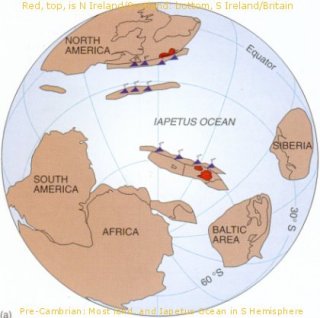
The origin, nature and conditions required for the proliferation of life forms remains one of the great unsolved mysteries of science. One possibility receiving serious consideration is that the earliest life forms came to us from space – perhaps from a nearby planet like Mars (and hence the interest in the experiments on that planet of the Mars rover vehicle Spirit).
Story : Indian Princess
[Before reading this, please note the caveats expressed in the previous story, The Art of Storytelling].
I was talking of P J Brannigan. Well, he was the great man for travelling.
He was in Crete that often he had a girlfriend there be the name of De Milo.
She belonged to the Heraklion De Milos.
Venus, her name was.
According to P J she was the powerful woman altogether for she invented the world’s first ever sleeveless T-Shirt.
He went to Berlin too, for it reminded him of his hero, John F Kennedy. He made a speech there one time. How’s this it went, now?
Och aye, it was …’ich bin ein binliner’.
He knew China too and developed a quare turn for the language. He says to me one time … do you know, says he, what CHOP SUEY is Chinese for? And of course I didn’t. Says he, with great authority,
CHOP SUEY is Chinese for ‘number forty seven.’
While the television was still a new-fangled article in his house, he couldn’t talk about anything else. I met him one morning on the road and he says to me, says he..
‘Were ye watching the television last night?’
‘I was,’ says I, – cause I was!
‘Had ye got it switched on?’ says he.
‘I did’, says I.
The ladies tennis final was on. That’s a good few years back.
‘Did ye see yar wan winning? Wasn’t she massive altogether.
What’s this her name was?
Ah yes.. NAV-RAT-I-LOVA.’
‘That’s right,’ says I. ‘A quare name altogether. NAV-RAT-I-LOVA.’
‘Aye. And she had a first name too. Aye. MAR-TI-NA!’
‘MAR-TI-NA NAV-RAT-I-LOVA’, says I.
‘MAR-TI-NA NAV-RAT-ILOVA’, says he.
‘MAR-TI-NA NAV-RAT-I-LOVA’.
And we were hitting the name forward and back a while, like we were playing tennis too. Then all of a sudden he stopped and looked at me.
‘Now, which one of the NAVRATILOVAS would she be?’
He was up in India one time. Or In’ja, as he called it. He was out on a lake fishing for pike. With a nail gun! And what did he do, only he put a hilty nail through the bottom of the boat. Luckily enough he was just beside this wee island in the middle of the lake. Aye, Woody Island, it was called. And he managed to wade over to it.
And it was just an oul dump. People used this island for a dump. A hape of tin cans – and Milk of Magnesia bottles on it. People found this very handy, for if you have a dump on an island, no one’s gonna rogue anything off it.
He was sitting there, hoking through the rubbish heap, when he came across an aul billycan. Ah, just an aul wreck of a billycan, all dented and blackened and that. But he thought, ‘sure I could clean it up and take it home, and maybe get a bitta use outta it. Keep aul bent nails or something in it. So he spat on the billycan and gave it a rub. And what came out only a genie.
‘I, am the Genie, of the billycan,’ says he.
‘You have one wish!’
Wee, poor P J was caught on the hop, and all he could say was..
‘I wish I was home and dry in my bed.’
‘Now,’ says the Genie. ‘That’s a very simple wish and I’ll make sure you’re magiced home. But I’ll give you a wee bit of a bonus too. You’ll be lucky for the rest of your life.’
And with that, the Genie disappeared into thin air.
He was going a bit thin on the top, you see.
Then who did P J see rowing across the lake only Oweny McGovern. And Owney says, ‘I’ll give you a lift.’ Owney hadn’t the nerve to ask him why he was sitting on the island with no boat. Anyway he brought him home and dropped him at the bottom of the lane where he lived.
As P J was walking up the lane, what did he see – stuck in the branch of a sally tree – only a ten pound note. And he thought,
‘maybe that Genie was right when he told me I was going to be lucky for the rest of my life!’
He took the note and filed it away in he’s ar*e pocket.
… we’ll get round to the Indian Princess soon enough ! …