The art of linen cloth production was brought to the north of Ireland by settlers in the seventeenth and eighteenth centuries. Prior to that the main thread spun and used in garment-making was wool.
Newry News and Irish Fun
 John McCullagh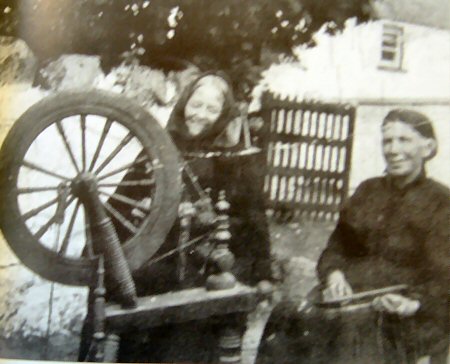
The art of linen cloth production was brought to the north of Ireland by settlers in the seventeenth and eighteenth centuries. Prior to that the main thread spun and used in garment-making was wool.
I lived outside in the barn in the first house I was hired to, said Kevin McAllister. If you didn’t finish your six months you could be done out of your money. There was no law to back you up. It was rough enough. They took three 2.5d stamps off me, for the letters I wrote home in that time. And 7d for plasters for the boil on the back of my neck.
Was there any difference working for Protestant compared to Catholic employers?
You were treated as well, if not better, by the Protestants. With them there was no work on a Sunday. With your own the real work only started on a Sunday! ‘Seven days a week, twenty-four hours a day, and the rest of the time’s your own!’ What kind of work?
Cleaning drains, carting out muck, harrowing (2-3 horses), you were often in sheughs to the eyebrows [I think that’s what he said!]
My next job I was paid
Give us our daily bread
Father in mercy hear our prayer
All hope in human aid is fled
We sink in deep despair.
Our little ones scream out with pain
And clamour to be fed
Father, they cry to us in vain
Give us our daily bread.
O’er the gaunt infant at the breast
The mother bows her head
The fount is dry, in vain ’tis pressed
Give us our daily bread.
Our eldest born, with hollow eye
And eager stealthy tread
Would take the food we cannot buy
Give us our daily bread.
We must not beg, we shall not steal
Though stores before us spread
But we will work with earnest zeal
Give us our daily bread.
Famine hath laid her withering hand
Upon each little head
O Christ! Is this a Christian land?
Give us our daily bread.
Thy will be done, Father receive
Our souls when we are dead
In Heaven we shall not pine and grieve
Or want for daily bread.
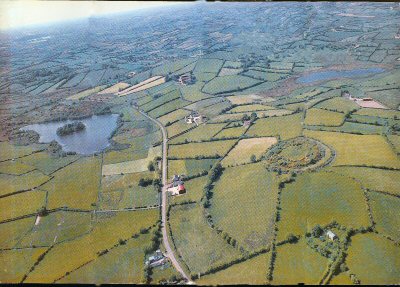
At the top of the picture are the townlands of Drumlougher and Kiltybane with Lough Patrick on the left. On the right middle is the famous three-ringed Royal Fort of Lisleitrim. There was once a souterrain on its top level but – though still existing – this has been filled in with soil.
From last year’s Newry Drama Festival programme, I note for the first time a warning of ‘plays that contain strong language’. I think any one exposed to TV is by now inured to all that. However if your sensibilities are easily injured you ought to know that Newpoint’s contribution this year (Festival begins on Friday 19 March) falls clearly into that category!
Your local director is again Sean Treanor, who carried last year’s Trojan Women by Euripides not just to provincial, but to national [international?] success when the group was offered a ‘wild card’ British national entry – and scored an outstanding success in England. We are informed in the pre-production flier that Portia Coughlan has a ‘richly textured dialogue’. That at least!
The perennial critics [I include myself!] who complain that the programme never includes a sufficient number of dramas by Irish authors will now be silenced. Besides Newpoint’s Irish entry, there are works by G B Shaw [Arms and the Man, an early comedy] Hugh Leonard [The Poker Session and Love in the Title] and Brian Friel [The Loves of Cass McGuire]. Then there’s the N Ireland drama The Force of Change. Other plays on offer in this nine-night feast of drama are My Three Angels (comedy), Ladies who Lunch (witty) and The Living Room.
As if all that were not enough, we have the All-Ireland One-Act Drama Finals in Warrenpoint from 23 April-1 May. I need a lie-down just thinking about it all.
But we will be there, each and every night. See you.
It is an enormous credit to the vibrancy of the community of Lislea, a fabulously picturesque district on the way from Camlough to Crossmaglen, that they are currently celebrating their 23rd Drama Festival. I recently skimmed through again Tom Keane’s booklet of the history of the area [now an unbelievable 30 years old!] and was enormously impressed. Newry library has no copy and neither have I. Any chance, Tom?
Last time I attended a play, it was standing room only. These thespians could teach Newpoint – or any one else, for that matter – a lesson. I’ll be among you for a number of your forthcoming dramas. Meanwhile, for those interested, the programme includes:
Callaghan’s Place – a play that examines the effects of isolation in remote rural areas. It is performed by St Dympna’s Dramatic Society.
Philadelphia, here I Come – the Friel classic, by Castle Players, Tyrone.
Playboy of the Western World: Singe; Wayside Players, Wexford.
Girls in the Big Picture: Belfast’s fabulous Marie Jones; Pomeroy Players, Tyrone.
Eclipsed: Drama Circle, Creggan. 1960s convent laundry (yes, you’ve guessed!)
View from a Bridge: Millar classic: Lislea Dramatic Players
They all need and richly deserve your support. You’ll be made welcome!
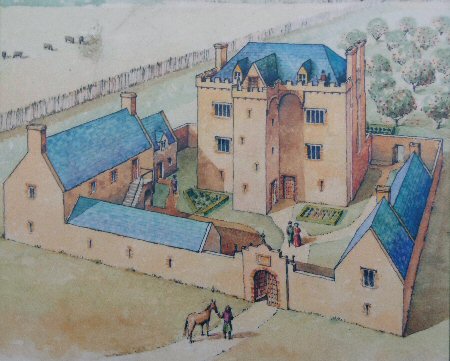
Before the final defeat of the Gaelic chieftains [Kinsale 1601: Flight of the Earls 1607: Plantation of Ulster 1609 on] the O’Hanlons were the primary clan in Orior …
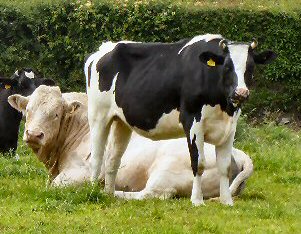
‘The winter of ’47 was very harsh’, Kevin McAllister told me. ‘There was often snow lying nearly to the roofs. Parties of men were sent out to dig the roads clear. One gang might suddenly dig its way through to another, coming from the opposite direction.
How did the country people survive?
Everybody had a few hens for eggs and a cow for milk. There was your small plot for vegetables and potatoes. You would only get a couple of bob per hundredweight if you sold them. The potatoes were riddled and the smaller ones went for seed. Inspectors could be awkward. ‘They wouldn’t take two stone to the hundredweight.’ [I don’t know what Kevin meant by this].
Cattle for sale at the fair were walked down from Fathom. They’d find every gap in the hedge! If the fair was at Camlough you’d have to run them there. At the cattle fair they were sold by bidding: at market, by auction [I remember watching this, fascinated as a boy, in the ‘pig market’ where the Sports Centre now stands].
It was mainly store cattle then. You only reared a calf until it was a year old. There’s more ‘finishing’ now with the availability of hay and silage. At the fair, some aul farmer would ask,
‘What do you want for skittery?’ The answer was,
‘Them that’ll slight my beasts will buy my beasts.’
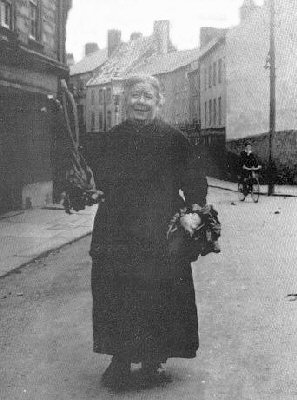
George Paterson, folklorist and archivist, collected sayings of the aul people as he travelled the country. Here is a selection.
‘A crowd of hares used till gather in the wee forth [fort] at night. They used till just sit there an’ even the ‘grue’ [greyhound] that cud see them well wud luk the other way. Me gran’father himself went in once when they were there. He saw the lot of them in the centre of the ring. But when they saw him they slipped into the sheugh at the forth. As soon as he left they were back on the rampar [rampart]. He was sorely bothered be them an’ one night he borrowed a gun an’ let them have it. [shot them with it]. An’ sure as yer here the nixt mornin’ there wus hardly an oul’ woman that wusn’t in bed.’
‘A man about here once followed a fairy funeral. He wus up late at night an’ heard the convoy comin’. He slipped out an’ followed them an’ they disappeared into Lisleitrim Fort. He heared the noise of them walking plain but he saw none of them.’
‘They wur goin’ to break up the forth in the days of my forebears but when the horses and plough wur upon it, a slice of bread was thrown right in front of them. It wus a strange thing to happen an’ they were bothered, but a wise woman told them that if the place wus left alone the Nugents would niver want for bread. An’ thank God we niver did even in the Famine time. It wus always a right fairy place.’
P.S. from Editor: Wudinye think, with a roughage like that in the family, that Peter Nugent cud buy his round, now and then?