John Mitchel of Newry

John Mitchel

John Mitchel (1815-1875) was a Young Irelander leader and perhaps the most esteemed republican to come from Newry. He was born in County Derry near the town of Dungiven on November 3 1815.
His father was a Presbyterian Minister and was called to serve in Newry.  The family moved to Drumalane House.

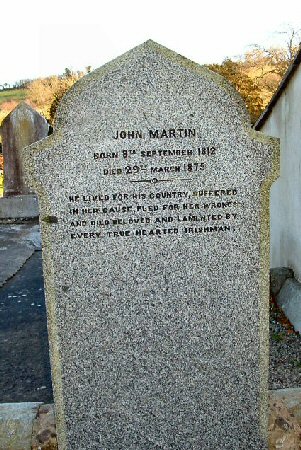
Young John went to the school of Dr Henderson in Hill Street along with his life-time friend and soon to be relation John Martin, another Newry republican hero of Presbyterian stock.  In the mid 1830s Mitchel graduated from Trinity College Dublin and was sent to Derry to work in the law office of his uncle.

It was about this time that he met and married Jenny Verner of Newry, the daughter of a ship’s Captain. They remained happily together (when not separated by enforced exile) until John’s death, thirty eight years later. In 1840 John Mitchel was sworn in as Attorney at Law. His church minister father died the same year. John and Jenny moved to the Banbridge area where he worked as a partner in the firm of Frazers. Mitchel worked hard at his legal practice, gaining a high reputation from all communities.

Our country was reeling from the punitive fiscal, trading, economic and financial measures introduced by the Imperial Government under the Act of Union designed to permit unfair advantage to England over Ireland in these areas. Organised resistance had been dealt a fatal blow by the massacres ordered in the previous generation against the United Irishmen and their supporters of the 1798 Rebellion. Few were prepared to raise a voice in protest.

John Mitchel entered the political arena when he began writing for the Young Irelander newspaper ‘The Nation’.  In 1846 he replaced Thomas Davis – that other great resistance hero – as leader writer for the paper  and the tone became immediately much more belligerent.  For the following two years leading up to the 1848 uprising, Mitchel wrote nearly all the paper’s political articles, invoking the hatred, wrath and finally reaction of the government while becoming the darling of the republican movement throughout the country. These writings reveal Mitchel’s writings at their best, surpassing even those of his illustrious predecessor.

The famine conditions of the 1840s had a profound effect upon him. The sight of his fellow countrymen sunk in the horrors of starvation, extreme deprivation or forced into impecunious exile left an indelible mark upon him. Travelling in Galway, he observed scenes that, he acknowledged, would never leave the memory of any observer. He wrote of

‘Cowering wretches, almost naked in the savage weather, prowling through turnip fields, endeavouring to grub up roots which had been left, but running to hide as a mail coach rolled by; very large fields where small farms had been consolidated, showing dark bars of fresh mould running through them where ditches had been levelled …. …sometimes I could see in front of the cottages, little children leaning against a fence when the sun shone out – for they could not stand – their limbs fleshless, their bodies half naked, their eyes bloated and yet wrinkled and of a palish green hue – children who would never, it was too plain, grow up to be men and women.’

Again in Jail Journal, he wrote …

Our footfalls rouse two lean dogs that run from us with doleful howling, and we know by the felon-gleam in their wolfish eyes how they have lived after their masters have died.  ..these people were our hosts two years ago.. they shrank and withered together until their voices dwindled to a rueful gibbering and they hardly knew one another’s faces, but their horrid eyes scowled on each other with a cannibal glare.  We know the whole story – the father was on a ‘public work’ and earned the sixth part of what would have maintained his family which was not always paid to him.  But still it kept them half alive for three months so that instead of dying in December, they died in March.  And who can tell the agony of those three months? … five children all dead weeks ago and flung coffinless into shallow graves – in the frenzy of their despair they would rend one another for the last morsel in that house of doom; and at last, in misty dreams of drivelling idiocy, they die utter strangers.’

John Mitchel, Jail Journal, 1854.

Mitchel called for violent, direct, military action to be instigated to drive the English out of Ireland. His open advocacy of armed rebellion was not supported by his more cautious, constitutionally minded colleagues so Mitchel left ‘The Nation’ early in 1848 and established his own radical newspaper ‘The United Irishman’. Through this he called for the overthrow of the landlord system and the establishment of an Irish Republic.

Three and a half months after its first publication, Mitchel was arrested by a frightened and uneasy government. It rushed through a special law at Westminster designed to deal specifically with him. This was the Treason Felony Act. John Mitchel was convicted by a packed jury and sentenced to fourteen years transportation. Without him the Irish rebels, weakened by three years of famine were unable to spark support from the defeated and disillusioned people and the Irish Rebellion of 1848 was the least successful of all those rebellions that swept Europe in that fateful year.

Mitchel was first exiled to Bermuda. A year later he was moved to Cape Colony and finally to Van Dieman’s Land (Tasmania) where he lived under parole, until he escaped to America five years later. He was well received by Irish exile in New York where he again established a successful paper ‘The Citizen’.  Unfortunately in the American Civil War of the mid-sixties, Mitchel supported the Confederacy and the cause of slavery.

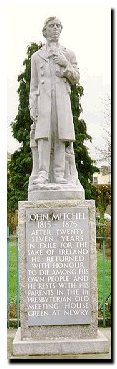
In 1875 Mitchel returned to Ireland and won a parliamentary seat in Tipperary, under an abstentionist ticket. His health had deteriorated and he was spending much of his days bed-ridden in Dromalane House. He died peacefully on 20 March 1875 and was buried alongside his parent in the Presbyterian Old Meeting House Green in High Street, Newry. His friend (Honest) John Martin caught a chill attending his funeral and himself died a few days later.

Mitchel’s surviving oeuvre – besides his newspaper articles – include ‘Jail Journal’, ‘Last Conquest of Ireland’, ‘Life of Aodh O’Neill’, ‘Crusade of the Period’ and ‘A History of Ireland’.  A statue in tribute stands in St Colman’s Park and many political and Gaelic clubs of the town have adopted his name in honour.

There remain, even in our town those who call themselves Irish, who know this to be a valid record, and still choose to excuse the Imperial Government, to explain the ‘poor’ landlords’ heartlessness, to argue ‘laisser-faire’ economics, to defend the Union, to vilify Mitchel in other fields of thought and endeavour.

In the American Civil War he sympathised with the South, lost two sons in the fighting and was for a short while imprisoned by the victorious Northern forces. He went to Paris where he observed his much-loved daughter Henrietta (Henty) – who had become a Catholic – die while still at school.
Answers to Deduction Posers

townsouthsepia.jpg

Reasoning 1: Answers


1          D         The two sentences here assume that concentrated study is a sufficient (as well as being a necessary) condition for academic success.


2          D         Try this yourself using an empty cereal packet and a Stanley knife.  Left is a triangular shape.  Eight of these create 24 extra sides to total 36.


3          B          The main conclusion is embedded close to the start of the argument:  that there ought to be a mass vaccination programme.


4          D         It is assumed that the only way spiders can harm people is by biting them (this doesn’t have to be true to be assumed within the argument)


5          C         The first line is the main conclusion of the argument – that people who win elections are never the right leaders (again, it doesn’t have to be accepted as truth – merely the main thrust of this argument).


6          D         That one place is unsafe doesn’t make other places safer!  The logical flaw would vanish if the last sentence were to begin..’If it were true..’ rather than.. ‘But as it is clearly untrue..’


7          E          190.  If there are 380 members now, half this number must have brought a new member each at the last AGM.  Indeed the number of new members any year must be equal to the number of existing members turning up for the AGM.


8          A         5.5 hours.  There is one hour each on Monday, Tuesday, Wednesday and Sunday, and one and a half hours on Thursday morning.

Read moreAnswers to Deduction Posers

Second Marriage

19CentCottage.jpg

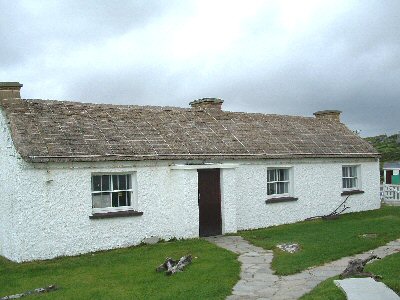
‘A woman died an’ left her husband sorrowing with a baby boy.  He’s grief wus tarrable, but quick an’ sudden over like, as such griefs sometimes are.  An’ before he’s wife wus more than coul’ in the oul’ burial groun’ of Creggan, he’s fancy wus captured by another.  An’ in a short time he wus again before the altar.


Read moreSecond Marriage

Meadow Memories 4

duffnersfamily50s.jpg

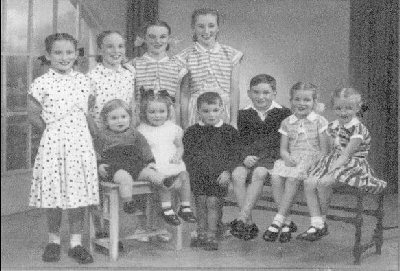
How did our parents manage to make us all feel important? My mum helped me when I was studying for the 11+. She was “expecting”. After the first few, all mum’s confinements were at home. The news was brought downstairs that the baby had been born. I rushed up to congratulate mum and see the new baby. I brought my books with me, and asked mum to help me again with my work.

So much for rest and recuperation.

And she did, though I don’t think she could see the pages too well!

Despite the large number of siblings in our house, I never remember feeling “left out”.

All these children are now grandparents in their own right!

Read moreMeadow Memories 4

James Fearon

JamesFearon.jpg

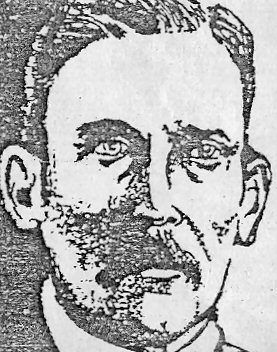
Three James’s were central to Ireland’s labour movement a century ago.  Perhaps the most famous is James Connolly who led the Citizens’ Army contingent at the 1916 Rising and who was subsequently executed for his part [strapped to a chair since his injuries precluded his standing]. 

Read moreJames Fearon

Newry’s Greatest …

martininscript.jpg

Newry`s Greatest

Who is Newry`s greatest?
An unusual & entertaining show is staged on Friday, 28th February at 7.30 p.m. in Newry City hall.

It is a good news story because it assesses who did most for the people of Newry since 1144.
7 characters from the past – ranging from the first Cistercian Abbot; John Richardson of Bessbrook; John Mitchel & Sean Hollywood compete to be Newry`s Greatest. The others are Richard Castle, canal builder; Francis Carvill, entrepreneur; & the Russell sisters, Mercy nuns & social reformers.
The Magnificent Seven will be championed in twelve minute power point presentations. Then an election takes place – the winner being decided by the audience using voting machines – a first in N. Ireland, probably. That innovation could attract people from all over N. Ireland, we hope.
Proceeds go to Concern Worldwide`s Syrian refugees.

Funeral Oration for Josie Keenan

JosieKeenan-239x300.jpg

Funeral Oration for Mrs Josie Keenan (nee O’Hanlon)

My aunt, Josie Keenan, was born Josephine O’Hanlon on 15th March, 1920, youngest in a family of 3 boys and 4 girls to Owen O’Hanlon and Emma McKnight.  Her siblings were Danny, my father, Katie, Mick, Emma, Rosina and John and they all lived together in beautiful Clontigora close to Hagan’s Bridge.

This idyllic start was soon disrupted as her mother, Emma, died while Josie was only two; a tragedy compounded by the death of her father, Owen, when she was four.

There was no cohort of social workers to take control and the children may all have been destined for an orphanage but for a far-sighted Parish Priest who declared that the family should be preserved intact.

Danny, then only 17, became the Man of the House and Katie, 16, the Mother. With a resilience that few today could achieve they survived and Josie grew up in a loving environment albeit without luxury. She attended the local Killian Primary School moving on, when the time came, to Our Lady’s and eventually to St Mary’s College in Belfast whereshe trained as a primary school teacher, a career choice which would be to the benefit of many children for the next 40 years.

I heard just recently, living eye-witness accounts of a very tall chemist seen regularly cycling the route from the Dublin Road in Newry out to Clontigora. Oliver and Josie would often be seen “stepping out” around the roads from there to the Flagstaff and beyond in a procedure as old as the hills around them but, no doubt, inconceivably simple to current generations.

They were a cultured young couple and I have seen their names on old programmes of both The Feis and Newpoint Players and Oliver often boasted to me of his on-stage achievements. It wouldn’t be the last marriage to come out of association in those organisations.

After the war there were not a lot of permanent teaching opportunities and Josie subbed in many schools.  She particularly mentioned her time in Dromore to which she would travel by bus and complete her journey on a
bike secreted away in the area for the duration of her term there. This bike was crucial to many of her  employments.  Indeed, Norman Tebbit, many years later might well have based his “on yer bike, plenty of work if you look for it” speech on Josie’s approach to job-seeking.  She told me of cycling from Clontigora to Ballyholland to teach.

All this hill work must have given her beautifully crafted legs because in those days, before celebrity culture, with Holywood making inroads even as far as Clontigora, she was referred to locally as Heddy Lamar because of her beauty and, it’s a fair word to use, grace.

In a family of brothers and sisters who, like Spinal Tap, had their amplification systems go all the way up to 11 instead of 10, she was the quiet, calm one who spoke with clarity and knowledge.

Oliver and Josie got married on Easter Monday 1949, the day the Free State became a republic.  We don’t know if the two events are associated but you could be pretty sure that Oliver had an opinion on the subject.

The young couple set up their home above Oliver’s chemists dispensary in Hill St and soon moved to Erskine St.  First born of this happy union was Maura, soon followed by Una then Tom and finally, Michael.

By this stage the family had moved out to Derrybeg Villas apparently because Josie was a country girl at heart.  All was perfect and, if we secretly called him Blessed Oliver Keenan, that is in fact what he was and Josie was devoted to him to her final day.

By this time she was working in the school which was to be her major employment and her happiest time in teaching: St Joseph’s Primary. She made strong friendships with Lilian Donnelly, with whom she worked, and Agnes McConville with whom she had been to school. I have heard many testimonies of her time in St Joseph’s one going as far as to say “your Aunt Jo saved my life. I was in the depths of despair in school until she came along”. She was both gentle and genteel. The most appropriate term I heard to describe her came from one former P3 student: “she was serene”, which, as any teacher will tell you, is some going in classes of up to 40 in those times. Her classroom was an oasis of calm and knowledge.

She dared to follow Oliver on to the golf course but in the course of many Keenan four-balls over the years was declared “a useless golfer”. Her pursuits were more intellectual: she was an avid reader; she had to the last an exceptional mind with a depth of knowledge; had memorised vast numbers of poems and was an avid crossword fan – to the end completing the daily Irish News crossword.

Eventually the family moved into Patrick St, very convenient to the local church. Josie was in every way the epitome of what we refer to in Newry as a “Dominican Catholic”. She was a devout believer and practitioner and most deserving of the term, The Faithful.

The family are most indebted to Martin who brought Oliver and herself Communion every 1st Friday allowing then to continue in the practice of their faith. May I mention one other lady. It is indicative of the old-fashioned and proper way of the pair of them that Mrs Evans, her constant companion and source of support, was always “Mrs Evans”: a lovely indication of old values and the mutual respect they had for each other.

And so the years passed. Maura went to Vancouver and on her many visits home would endure the gentle taunts to retire to Newry. I think Josie admired that spirit of independence. Una married Brian and have Josie and Oliver’s grandchildren, Claire and Mark. They must have paid more tolls on the M1 than any of us in their regular visits to mum and dad.

Tom whose beautiful mind was sadly compromised in recent years, a cause of much heartbreak to her; Michael and Karen with the grandchildren Cheryll, Rory and Kim and, indeed, two great-grandchildren were a tireless source of care and support.

Mary O’Hare was like a spare daughter to her and Gerard also. Any time I would come in she would stare blankly at me and say to all around her: “I don’t know this person. Who is it?” causing me great concern.

The twinkle would come in the eye and she would say,”It’s so long since you came to see me I didn’t recognise you”.

To all the care workers. Thanks are inadequate. They were independent and un-institutionalised because of your devotion. You are priceless.

The Keenans and their children and extended O’Hanlon family kept watch and supported in so many ways for which the family express profound gratitude.

Josie died as she lived, with grace and dignity and we are all diminished by her absence. My greatest memory is of her generosity to me as a young only child without a father and of how she and the entire Keenan clan embraced me, and of her intellect.

I paraphrase Goldsmith:

While words of learned length and thundering sound
Amazed the gazing rustics ranged around,
And still they gazed, and still the wonder grew
That one small head could carry all she knew.

Donal O’Hanlon 8th December 2013