INF, Warrenpoint

This was another successful ‘Rock Night’ for the Warrenpoint INF (Irish National Foresters on The Promenade) in what must surely be the heart and soul of the Newry and Mourne music scene!
 
Headlining was the group ‘Existing Threat’ who bashed out their own brand of Death Metal.  This four-piece from Newry may not be for everyone but the set was fast and heavy and seemed to appeal to the greater part of the audience.
 
The night also saw local heroes ‘Black Alley Screens’ woo the crowd with their mix of funky Grunge and Inde.  Just back from  a brief stint in Oxford, England the Screens have honed their set to help appeal to the majority of musical styles and tastes.
 
‘Savage Hennery’ certainly got the crowd jumping as they opened the night’s shenanigans.  This jazzy four-piece raced through an interesting set ranging from white stripe covers to their anthem ‘Simultaneous Rainbow Lovin”.
 
All in all, a great night out (for those who can remember it!)
 
The INF Warrenpoint hosts these weekly ‘Rock Nights’ with doors opening at 9.30.  

She wus lame, anyhow!

RockyField.jpg
A man in Killeavy could get no milk from his cows.  Somebody was taking the best of the milk.  He put a charge in he’s gun one night and a handful of silver for colpher.  
 
He watched and he saw a hare slip in till the byre.  As it come out he blazed at it and hit it about the hip an’ it got away.
 
But the country said it was Jane O’Hanlon.
 
She was lame after anyhow!

Referee over-reacts!

mountcaulfield.jpg
Congratulations to the Irish team which comprehensively defeated the Aussies today in the International Rules Series to win both the game and the series.  Admittedly there were a few dubious decisions by the Irish referee, especially in the second quarter, that penalised the Australian team.  There were lots of incidents, including many’s the lively row on-field but the referee escaped public censure.
 
The outcome was not so satisfactory in Eastern Cape, South Africa when Ekithumpi met Soarnoseni.  The South Africa Football Association was quick to issue a statement after that game, to deny any responsibility for its after-effects.
 
‘Some of the Soarnoseni players objected when the referee gave one of them a yellow card.  A row broke out and some of the Ekithumpi supporters stormed the field.
 
The referee was quick to pull a pistol and immediately began shooting at them.  He shot the Ekithumpi coach dead and seriously wounded two of their players.  He ran off the field shouting, ‘I am the master of the Universe’.  He has not been seen since.
 
We are unanimously agreed that the referee over-reacted in this instance.’
 
A later statement was issued when all the facts became known.
 
‘The referee that officiated at this match was not a properly qualified official registered with Safa.  He was one of the spectators asked by the organisers to handle the match.  Safa passes its condolences to the family of the coach and of the injured players. 
 
If any of our referees feel it necessary to arm themselves before a game, we do not recommend a loaded pistol’, the statement concluded.

Fews Glossary: R 3

Lislea.jpg
Right            complete, thorough, ‘he’s a right gentleman’
Rightly         fine, ‘I’m doing rightly, thank you’: well, ‘I know it rightly’
Rigmarole    a convoluted, unbelievable story
Rise             rib, take a hand out of, raise his temper, ‘don’t rise him!’
Rogue                   v. cheat, ‘he’d rogue ye if he had the chance’
Roughness   plenty
Rub              n. praise or disparage, ‘he’d give ye a wee rub’
                   ‘rub of the relic’, euphemism for sexual relations
Ructions       a hullabaloo, a row, ‘he raised ructions over it’
Rue              regret, repent,  ‘she rued the day’
Rug              to pull
Rummel       to shake
Run              leak, ‘the water has all run out of the pot’
Rung            step of chair or ladder
Runner         a person who is always in someone else’s house, ‘ceilier’
Runs            goes, of inanimate object, ‘the road runs till Armagh’
Runt            small, the reject
Rust             to take fright, to refuse, ‘the horse rusted on me’


Ground Rules for Cures

ramblers45.jpg
A number of stipulations accompany the cure.  The curer often must not ask for or acknowledge the receipt of a gift as payment for the service.  They may accept the gift only if it is not acknowledged.   It is to protect against fake healers who are in it for profit.  Usually the healed person too is forewarned by others who have recommended the healer, that he/she must not offer recompense nor indeed even say ‘thank you’.
 
Cures or the power of healing are said to be possessed by the seventh son of a seventh son:  others believe too, by a seventh son; a seventh daughter or the seventh daughter of a seventh daughter.  The power once owned can disappear if for example a cure for human complaints is used to cure an animal.  Some Holy Wells became useless and abandoned after horses, for example, were brought to drink and be mended there.  Others may have the ‘cure’ of specific complaints.  We will write of that next.
 
Many priests in the past had the cure.  Some have been renowned as faith healers (Padre Pio) and have made use of the gift openly. 
 
If a charm is used there is usually a requirement for its repeated use three times to be effective.  Many of the cures must be done at a certain time and in the case of herbal cures some of the herbs must be picked or prepared at certain stated times.  Certain cures involve the use of an object such as a small white stone (which is required in at least three of the cures for bleeding). 
 
The connection between religious belief, faith and healing has a long history in Ireland that precedes the coming of Patrick.  These traditions of charms, herbs, the use of wells and standing stones, became absorbed into the Christian tradition.  We conclude this article with reference to P. W. Joyce’s story of the Tuatha De Danaan.
 
In the De Danaan history, the leech-god or physician god Diancecht had great healing skill.  During the second battle of Moytura when the De Danaan fought the Fomorians, Diancecht chose a health-giving well ‘into which he put a number of sanative herbs gathered in every part of Ireland’ and over which he and his daughter and two sons chanted incantations.
 
During the battle all wounded De Danaan were brought here from the field and plunged into this bath.  They all came out whole and sound and ready to do battle again.  Unsuprisingly the De Danaan won.

Where The Lark’s Still In Song

workers030.jpg
Oh Grandpa, I’m taking this pen in my hand
To tell of the changes that’s happened this land
In big, swanky houses we’re living in style
But they’ve wrecked and they’ve poisoned this Emerald Isle.
 
Remember the corncrake in the meadow would call
Well, the nearest you’ll find one is West Donegal
It was grand when Granny would bring us the tae
When you done the pitching and I built the hay.
 
Some people sit silent half the day and all night
Sure I’m thankful eventually when they put out the light
Of that box in the corner – it’s pictures they watch
From garbled conversing, the odd word ye might catch.
 
You know how the neighbours from the wee house’d call
An’ they’d tell all their stories, the big and the small
Ah ’twas grand when our Granny would get up to say
‘There’s new griddle bread for a wee drop of tae.’
 
You’ll mind the wee planting where the wild woodcock lay
How the larks in the springtime make their nests in the hay
Well, now they cut silage, foul slurry they spread
The larks’ nests are ruined, the woodcock is dead.
 
And sometimes you taught me in the brook to catch trout
With a twist of your hand you could scoop the fish out
Och ’twas grand when the sun made the pure water gleam
Now the farmers and factories have poisoned the stream.
 
I can still feel my feet catch the new stubbled sod
When you scythed the corn and I held the rod
The long-snedded scythe o’er your shoulder you’d heel
The stone made sweet music as you honed the fine steel.
 
But now there’s big combines in the fields all around
That in ten dusty minutes cut an acre of ground
But for all their great power, they blight my new dawn
For the scythe, like you Granda, is buried and gone.
 
Each evening you’d loose out the horse to be fed
And I rode on his back as you walked at his head
And although I’m near sixty I still feel his sweat
And my heart it feels heavy, and my eyes they are wet.
 
For I still see his collar where it hung on the jamb
And the pig that we killed for the bacon and ham
How you walked from your work and I sat on your head
And the sweet air was scented with Granny’s baked bread.
 
As you sat at the milking, on the cow’s side you’d lean
Now the cows are all joined to a milking machine
Even they now have their parlours, like the toffs in your day
And we open a bottle to milk our wee cup of tae.
 
But my life is near over, why should I complain?
As I sit and look out at the bleak acid rain
But I’m sad for the children as I watch them at play
They’ve dumped their foul waste and polluted the say.
 
So goodbye to you, Granda, though I still could go on
About things that are past, about days that are gone
But it’s well to be you that has had your long day
When we worked with the horse; with a fork made the hay.
 
And we kept the best straw for to mend the old thatch
Whereas now on our trousers you’d ne’er see a patch
Och it’s now that I’m thinking I’ll see you ere long
Where’s there’s fish in the streams and the lark’s still in song.


Sundays Wells

jungle.jpg
The tradition of visiting Holy Wells (or Sundays Wells) in search of cures or relief from distress was strong in Ireland until recent decades.  In this area were St Bridget’s well at Faughart and St Mochua’s Well near Keady as well as an acclaimed Sundays Well in the Glen area of Newry.  The latter has fallen so much into disuse that it is almost forgotten although it can be found marked on most old maps of Newry.  We would like to know its exact location, if any of our readers can inform us.
 
St Bridget’s Well at Faughart is still held in high repute and it is impossible to visit in daylight hours without meeting with some faithful pilgrims.  The bushes that protect the well are bedecked with pieces of cloth or rags, religious objects like rosaries, or other mementos, possessions of the one for whom the cure is sought.  St Bridget’s Day, 1 February is a day of special pilgrimage still and throngs attend to this day.

Carlingford Forest

199407_glen_panoramaglen.jpg

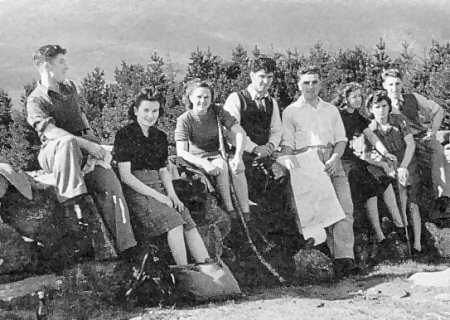
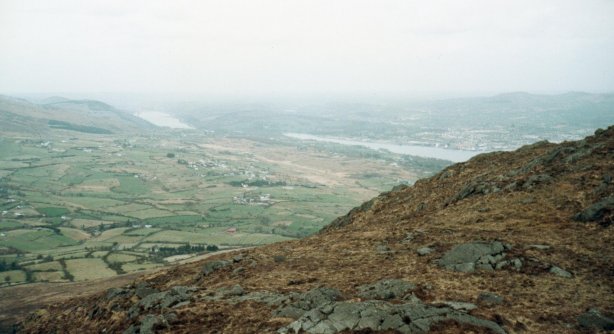
Fresh woods and pastures new, as promised.  Don’t get jealous – you’re welcome to join us by arrangement!  Forestry workers in both jurisdictions are currently ‘cropping’ so access is restricted.  We had perfect weather.  Then thunder and hail later when we were back home.  The gods are with us!  Have you ever seen more beautiful?  The views are nice too!