The Rose

jungle.jpg

We have John and Annette Macan with us for three weeks and yesterday your editor gave them the personal touch, with the whirlwind tour of the Ring of Gullion.  They were greatly impressed and why would they not be? 

I learned that besides professional counselling, John dabbles in acupuncture and Chinese herbal medicines.  For the benefit of the odd patient not partial to pin-cushion treatment, I print below one traditional Irish cure for a common ailment. [More ‘cures’ later!]

Erysipelas as you know – or your medical dictionary will inform you – is a skin disease involving a diffuse and spreading inflammation of skin and subcutaneous cellular tissue especially of the face, neck, forearms and hands, caused by Streptococcus pyrogenes.

Too technical, all that!  This is what my source, an old lady from Annahaia told me of it.

It might take ye anywhere but it’s a gentle thing, a very gentle thing, an’ the cure is one the doctors know nothing of.  Your head might swell up big an’ red as anything.  The Lord save me from having it agin an’ keep ye from it too.

I was tuk till the bog-hole but I first went till the doctor.  An’ says he,

‘It’s some oul’ woman ye want!  It’s she will tell ye what till do.’ 

He wus Dr Quinn’s father and the quare civil man.  I min’ the lot of them an’ sure the world an’ all knowed me. 

I’m the aul’ standard, I am, an’ I nivir lay off me work yit, even when I had me ankle sprained in the flax-hole.  There’s no dirty blood in me or anything like that!

But ‘The Rose’, God save ye from that!  It wus in me face I had it an’ it wus in a terrible rage.  But min’ ye, ye cud take it anywhere:  in yer legs or in yer feet.  But sure it wus in me face I tuk it. An’ the cure wus a boy an’ a girl whose father and mother wus livin’ an’ nine wee stones from off the road. 

It wus Peter tuk me an’ we went till the oul’ Red Bog at Larry’s, an’ Peter threw a stone in the name of the Father, Son and Holy Ghost, an’ then lifted water an’ bathed me face. 

Then he stuck he’s hand in the bog-hole and brought out a poultice of bog-mud that wus placed on the spot, an’ sure in the mornin’ it wus gone. 

An’ I wus big then, a near grown girl, but I min’ it worked well.’

You’ve got bogs in the Brisbane area, don’t you, John?     


Which reminds me!  Paddy and Seamus Murphy determined to put the past behind them and emigrate to Australia.  It was slowly explained to them that things weren’t that easy any more.  Way back in the 50s, Australia would take most applicants but now they wanted only skilled tradesmen.  They had to undergo a test.

‘And what do you do, by way of making a living?’ Paddy was asked.
‘Oh, pilot!’ he  replied breezily.
‘That’ll do fine!’ says yer man of the Embassy.  ‘We can always find work for a man of your talents.’

Paddy left smiling and gave the thumbs-up to his brother Seamus who was entering for interview after him.  Seamus smiled in response.

‘And what do you do for a living?’ Seamus was asked.
‘I’m a turf-cutter,’ Seamus replied.
‘I’m sorry Seamus, we have few bogs in Australia and no work for men of your talents.’

Seamus was devastated. 

‘But you let my brother Paddy in,’ he countered.

‘But he’s a pilot!’ the Ambassador said.

‘Sure he can’t pile it till I cut it!’ Seamus rejoined…
 

Fews Glossary: I

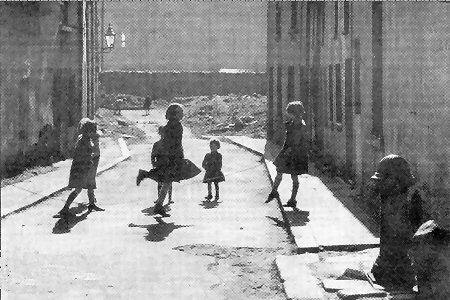
ballymac.jpg

Ill-answered  impertinent
Ill-favoured   physically unattractive
Ill put-on      badly dressed
Ill done        done wrongly
Ill to handle  difficult (of person or beast)
Ill off           in straitened circumstances
Ill tongued    prone to swearing, or verbal abuse
Took it ill      was displeased about
Imparted      scolded: ‘I imparted my mind to her!’
Imperent      impudent
Ins and outs  all: ‘give me the ins and outs of it!’
Insense        to make someone understand
In under       beneath: ‘he fell in under the cart’
In with        on friendly terms: ‘Are ye in with them?’ 

I know these are out of sequence but I’d better record them before I forget.  I’m grateful to my friend Bridie McVeigh for the second one below.

Yer ar*e ‘n parsley  You’re telling whoppers!

Ceillayly: She’s just an aul’ ceillayly  She’s flighty and fickle – always on her ceili

Weather Signs

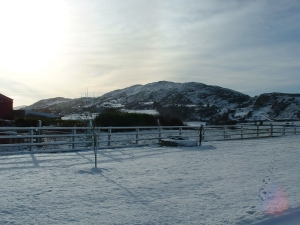
BernishSnow.jpg

If it rains on St Swithin’s Day, it’ll rain for 40 days

Cows huddle together before a storm

When the wind’s in the west the cuckoo’s in her nest

When a dog eats grass it’s a sign of rain

A wind from the East is bad for man and beast

When the robin ventures indoors, hard weather may be expected

As Friday’s weather, so Sunday’s weather

Rain on Sunday, rain all week

If bees work around the hive, the rain is near

If the cat sneezes it is a sign of rain

March of many weathers

If the oak is well-acorned it’s a sign of frosty weather

If the frog wears a golden coat, the weather will be fine
If he puts on his black coat, rain is on the way

A sloe year is a woe year

A haw year is a braw year

A ring around the moon is a sign of bad weather
If the ring is close, the storm is near, if distant, further away

A wind from the south-west foretells wet weather

Candlemas storms and Lammas floods must come

The March winds had almost killed the old cow, so March borrowed a day from April to finish the job

It’s cold weather for snedding turnips!

Men of the Roads

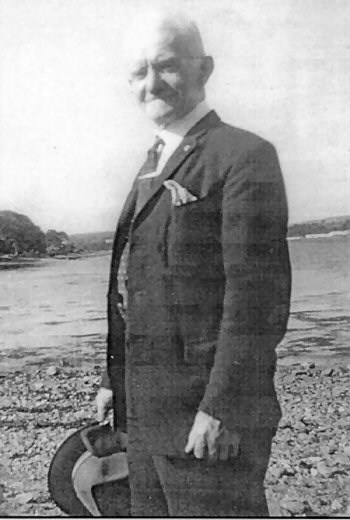
hughmallon.jpg
John the Tailor was a big rake of a man who called about once a year.  He was a travelling tailor and a great talker.  He stitched up any torn clothes in the house and he talked incessantly as he sewed.  He had a fund of ghost stories and told them well, so well that his audience was afraid to go out after dark.  The phouca (fairy horse) might get them if they did, or the headless horseman, or the black dog with eyes like coals of fire.
 
All John’s ghosts had eyes like coals of fire, the headless horseman excepted.  Usually flames issued from their mouths and the charms against their powers were a hazel stick cut when the moon was full, and a steel knife.  Failing these antidotes, one had to sprint for the nearest stream for ghosts and phoucas, as everyone knew, could not cross running water.  ‘They’re not so plentiful now because the clergy has banished most of them,’ said John ruefully, as if he resented their interference.
 
The fiddler MacDonald was another visitor.  He was a tattered man with a fiddle and mad eyes.  Everyone believed he played for the fairies when they danced in their magic ballroom, hidden in the secret places of the raths.  He knew all about the leprechauns, where they worked and where they had their crocks of gold.  But he didn’t lust after their gold, preferring the company of the ‘Good People’ to coveting their wealth.  He always went out of his way to please them.
 
‘Never pluck up a lady finger [foxglove],’ he warned us children.  ‘The fairies put them on their fingers when they’re dancing.’
All this happened long ago.  Old John Morgan’s dreamy eyes are now closed and John the Tailor’s talkative tongue is long silenced.  Old MacDonald the Fiddler has left his beloved leprechauns and fairies behind him and has gone to a better, brighter world.  When I often think of them, again I am a boy sitting on lichen-covered rock gazing down the Old Bog Road for my kind, story-rich men of the roads.

Fabian Rides Roy-Rodgers fashion

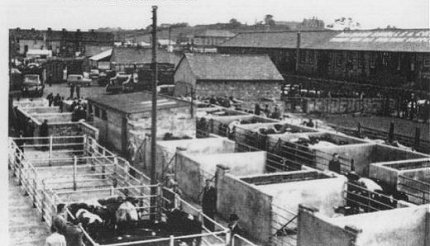
market.jpg

Fabian Boyle is our most esteemed local journalist.  He presently writes in the Democrat but formerly for the Irish News.  He reminisced on life in St Mary’s Street after the war. 

‘My father started a greengrocery and fish business in the market at Newry.  He married Margaret Hearty from Dorsey and their first home was in Mary Street.  In the mid 30s the first of his five sons and daughters began to arrive.

We were fortunate in that period of food rationing that my father’s business ensured that vegetables, some fruit and fish were available.  My mother’s culinary speciality was herring baked with bay leaves!

My father would collect the gleaming, silver herring from Kilkeel in the early morning and hawk them by horse and cart all over South Armagh, from Dromintee to Camlough.  My job was to corral the trusty steed from a field at the top of Courtenay Hill, using a hunk of bread as inducement and a rope for capture.  I’d walk him down the steep hill to the entrance with Mary Street.  Then I’d mount and gallop, like Roy Rodgers, down to the market entrance.

Plying his trade at the market-gate, my father would describe the herrings as ‘fresh, fair and lovely as a newly-married woman!’  Again, he would cry, ‘they’ll melt in your mouth and run down your belly like a racehorse.’  He may have been obsessed with newly-weds, for he’d also say, ‘great for young married women.  Makes them jump in their sleep!’  With every dozen he’d always throw one in ‘for the child!’

More later!  

Cooley Peninsula Slideshow

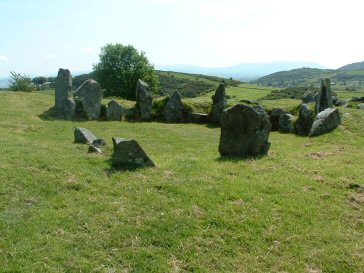
This latestest slideshow was made for Dan Callaghan of NY, USA who contributed to Guestbook.  Fathom Mountain – containing Killeen – out of Newry continues into the Cooley peninsula, famous in legend for the Tain Bo Cuailgne, the Brown Bull of Cooley and Cuchulainn.  St John’s Castle is in Carlingford.