Those of us lucky enough to grow up in The Meadow of the 50s and 60s had a number of McCrums as pals – I remember with fondness the late Eamon, with whom we’d play football in the Big Green – then there were Terry and Liam who were of an age with us, class-mates and pals, and there is Martin (altar-boy in St Bridgets) and Finnoula.
John McCullagh
Drama Festival Result
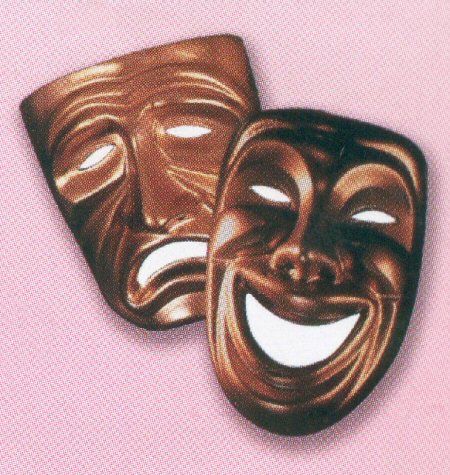
It is seldom that my critical review coincides so exactly with that of the Drama Festival adjudicator, so I am particularly pleased this year. I predicted 1st, 2nd, 3rd and 4th in the correct order and that Barbara Jeffers would pip our own Patricia McCoy to the best actress award.
Best actor was harder to predict as, unusually, there was a dearth of strong male roles throughout the nine productions. No one could quarrel, however, with Donn McMullin’s awarding of that accolade to Conn McAlister of Belfast’s CB Players for his role as Detective Sergeant Simpson in Gary Mitchell’s powerful ‘The Force of Change’. I admit to difficulty with discerning between the play and their interpretation of it, for I found it fascinating enough to view a perspective so different from my community’s [and especially my own] view of the partiality of the RUC – that is, religious and community, rather than specifically gender. Perhaps even more interesting was acknowledging how much has changed, as this most current of all the nine nights’ productions, already felt so dated!
Newpoint picked up eleven awards altogether, which I felt – despite my strong partiality in favour of the ‘home’ team – was somewhat over the top. A huge amount of effort on the part of many amateur thespians went totally unrewarded and I fear some might be dissuaded from further thankless effort in future years. I would not wish any one to be promoted over more worthy rivals but surely there were many close calls where teams other than the host would have been worthy winners. By way of example, allow me to suggest Best Lighting might have gone to Sundrive: Best Moment of Theatre to Lurig for the uncovering of the dead body and either best supporting actor/actress [rather than both to Newpoint] to some player from one of the teams that won nothing else [or one award only]: Mark Irvine of Rosemary and Michael Heffernan of Gorey are two possibilities for the former; Laura Ivers [Bangor] and Stephanie Leeman [Rosemary] for the latter. I wish in no way to undermine my friends Mark Hughes and [his real-life sister-in-law, on stage wife Denise Taylor-Hughes!] whose performances were exceptional, but they are about to be further rewarded with appearances at the Opera House, Athlone and perhaps – if sponsorship be forthcoming – the British Amateur Finals again, and their talents fully rewarded there. The others I mentioned return to the relative obscurity of civilian life for at least another year, and perhaps for ever. I’m not happy that that is deserved! Though I was delighted with Donn McMullin’s performance as adjudicator – and would strongly urge the Drama Festival Committee to invite him back next year [he has clearly indicated his willingness to return] I offer these few observations as positive and constructive criticism. It must for example be disillusioning – if not incomprehensible – for a group on two successive final nights [Portadown and Newry] to win the top award in one, and literally nothing in the other! I’d take Donn before that other, but, to get nothing for one’s efforts over months is undeserved!
It was a great festival. I loved it all. My dear wife, who looks forward to these nine nights of great drama every year almost as much as I do, was ill and attended only the final two nights. Still, now there’s Warrenpoint and the All-Ireland (Confined) Finals. Also Sean Treanor and his great team will go on to further success. It may be further presumptive of me but I’m on a predictive roll. They’ll win Ulster and perhaps even the All-Ireland at Athlone [by the way, they haven’t yet even definitely qualified for the latter!]
Latest: As expected, Newpoint have qualified for All-Ireland Finals. As a treat, two performances are now scheduled for next mid-week [end of April] in Auditorium of Sean Hollywood Arts Centre, in preparation for Ulster Finals in early May. If you haven’t seen Portia Coughlan I recommend you use this opportunity.
Crossmaglen
Crossmaglen has been recorded on maps since c. 1609 but until the late eighteenth century it was but a small collection of houses. A generation later and it is described as follows in Lewis’s Topographical Dictionary…
Lilslea Drama Festival 2007
The 26th Lislea Dr
The Canal and Towpath
To the people who lived in the
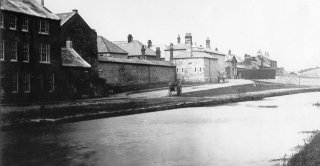
Within a short walk from their front door the canal towpath enabled them to take a leisurely stroll out into the countryside. To parents it was somewhere to take their children for a walk on a sunny afternoon, and to the children themselves the canal and its associated towpath was an adventure playground, albeit an out-of-bounds one to some of the younger, unaccompanied kids.
The good folk of the Square always looked upon the towpath as their own special domain. This mindset was probably brought about by the fact that
To some of the people who lived in Linenhall Square (The Barracks) a generation before me – that is, those folks who lived there during the Second World War – the canal towpath was their escape route following the sounding of an air raid imminent-warning siren. It was the considered opinion of those persons that during an air raid it would be a lot safer to be out in the countryside and away from any built-up area.
This particular belief was made more poignant following the horrific air raids on Belfast in April and May 1941, and also following the alleged radio broadcast by William Joyce (Lord Haw-Haw) that the Luftwaffe might bomb Lindsay Hill (well, at least knew how many steps there were up to St Clare’s Avenue!).
The unfortunate truth of the matter is that free-falling bombs released from aircraft travelling at speed on a dark night are not the most accurate of weapons; so therefore the people who favoured exodus from the Square, to Brady’s field, would most probably have found it a lot safer and more comfortable to endure the claustrophobic confines of the Linenhall Square Air Raid Shelters. Fortunately this was never put to the test as Newry escaped the war free from aerial attack.
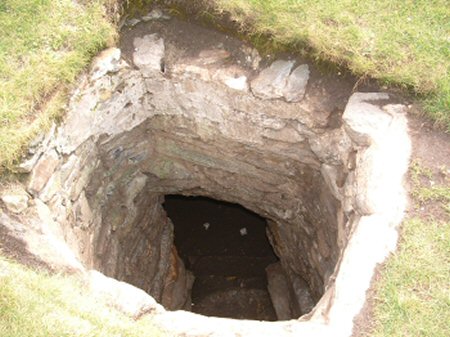
…. the weir …
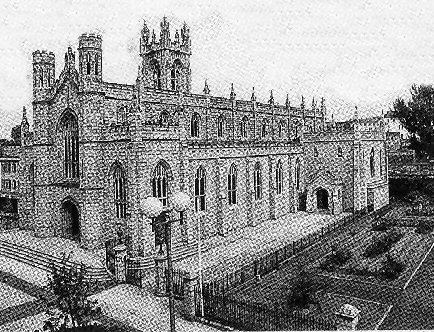
Cathedral in 20th Century
But the most extensive structural extension to Newry Cathedral awaited the raising to the Dromore Bishopric of Henry O’Neill in the first decade of the twentieth century. He served as Bishop 1901-1905.
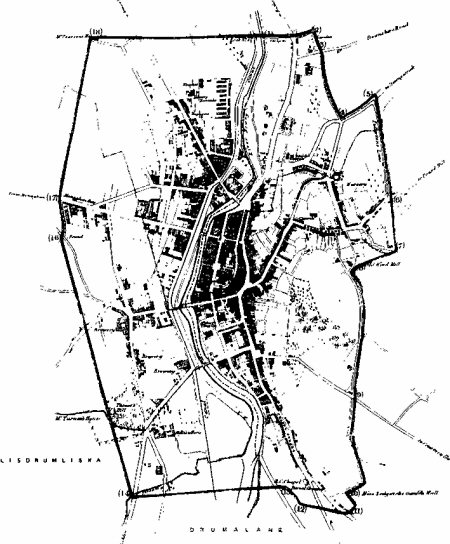
Town Boundary from 1839
In the century following the opening of the
Cistercians
The Cistercian Order of monks was founded in Citeaux, France in 1098. Religion was still the driving force of western civilization and this new order was dedicated to a return to the austerity that earlier had characterized the followers of St Benedict. They had spread the gospel and the monastic influence – which some centuries earlier had permeated Europe out of Ireland – far and wide. Rome saw the Cistercians as an important weapon against complacency and corruption in the monasteries.
Christianity in Ireland had strayed somewhat from the discipline and influence of Rome. St Malachy in Ireland was an important religious reformer. On one occasion when he was summoned to Rome for guidance and instruction, he stopped off at Citeaux. He was so impressed by the monks that he determined to invite them to set up some houses in Ireland. In 1142 a number of Cistercian monks did exactly that at Mellifont. Two years later a house was established in Newry. By the end of the twelfth century they had 27 establishments the length and breadth of Ireland.
Most, including that at Newry lasted for four hundred years until the Tudor monarch Henry VIII coveted the lands, wealth and influence of the Church and decided upon the ‘dissolution of the monasteries’.
Joey’s prayers answered
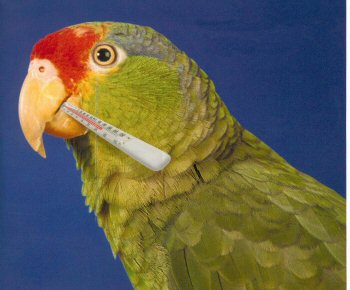
It’s best, I presume, to keep two parrots together in the one large cage for company for each other.
The widow woman had inherited the birds ……