Ballagh Millstone

WomenAtWork.jpg

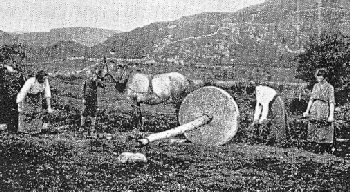
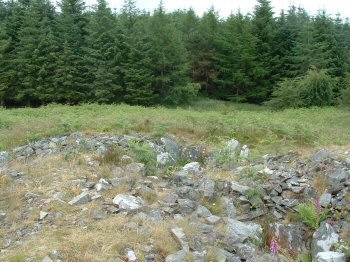
On the edge of the Calliagh Berra’s lake on the top of Slieve Gullion is a massive millstone, clearly recognizable in the photo from its circular shape and the hole in the middle. I’ll tell you the story and it’s the God’s truth, for indeed any other attempted explanation would be preposterous.

There was a time when the milling of corn was one of the chief, and indeed the most lucrative enterprises in the country. People have to eat, don’t they, whether in war or in peace? And the owner who has the hardest, and most long-lasting and largest millstone, capable of grinding the greatest quantity of wheat in the shortest space of time and over an extended period of many years, clearly would have the advantage over his rivals.

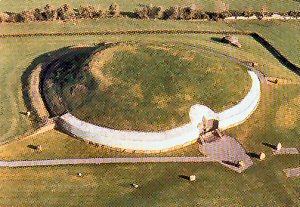
There was a mill in the Ballagh district one time in need of a new millstone and the owner, one Peter O’Mara was determined to outshine his rivals. He knew that the granite stones that made up the stone-age passage grave on top of Slieve Gullion could not be beaten for their hard and long-lasting qualities. He cared nothing for the customs and long-held beliefs that these graves should not, at any cost, be interfered with. In the middle of the night – for despite his callousness, he cared not to let his neighbours know the source of his new millstone – he arranged to have one of the largest and appropriately shaped granite rocks removed and transported to his mill. It took little shaping to turn it to its new purpose and in no time at all, it was grinding out meal by the ton. Peter’s mill thrived for many a day and he became rich.

But like all before him and since, that dared to interfere with things of the ancestors, bad luck plagued him thereafter. Though his mill thrived, his cattle and indeed his family did not. His cows were dropping off with all sorts of disorders and over the space of a few years he lost his wife and three of his children to strange diseases. It was an oul’ neighbour woman that suggested to him that maybe he had done something to bring the curse of the gentle people upon himself. Then he knew.

He arranged, as fast as he could to right this wrong. But it was easier for the oul’ donkey to carry his heavy load down the mountain than it was to carry it back up again. He was but two hundred metres from the passage grave, at the side of the Calliagh Berra’s lake, when he dropped down dead and the millstone landed in its present location.

But no more harm came to Peter for his intention was good.

And if you can think of a better explanation why that stone is there, well, I’d like to hear it!
In The Forth

LongStone2.jpg
In the fort one time there was a lone bush so large and branchy, ye cud have stud under it all day in the rain without iver getting’ wet.  About a ton of stones lay aroun’ it near till the size of ducks’ eggs, but what they wur there for nobody knowed.  The tree itself wus blown down on the windy night an’ carried right across the fiel’s to the road.  But nivir a sowl laid han’s on it or touched it until it wasted away of itself.
 
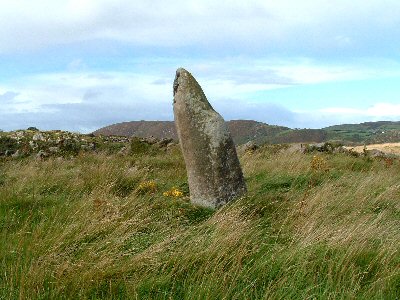
Near the same fort too, just outside the ring, there wus at one time the finest pillar-stone in Ireland, but oul’ Mrs Rice had it destroyed.  An’ it wus she had the bad luck, all her cows dyin’ of disorders, an’ she claimin’ compensation off two townlan’s an’ blackguardin’ her dacent neighbours.
 
But the same Mrs Rice, she went too far when she cut down the oul’ thorns on the fort.  But God rest her, she cud nivir see the harm in it.  She nivir saw another winter!
 
The fort was always a gentle place.  I mind me father that’s dead this many a year – he’d be a hundred today if he wus alive – hearing the finest music there that iver wus heared.  Deed the finest music that iver wus heared wus nothin’ till the music he heared at the oul’ bush in the fort.  An’ the light wus beautiful an’ playin’ all aroun’ it.
 
An’ another fort here wus clane destroyed be John Brady.  He wus one of the wealthiest men of his day – with a dozen race-horses, an’ mebbe more, in England.  But he lost all his money an’ people said it was well he come till no worse.  An’ there wus another lone bush in Ballyheridan of great repute on George John Fleming’s land.
 
An’ tuk it down and’ burned it, he did.  An’ he wasted right away.
 
An’ he a man of thirty-four acres!

Fews Glossary: P 1

foreststones.jpg
Dialect ‘P’ 1
 
Pack            friendly, ‘them two’s very pack’
Pad              path
Paddle          walk, ‘he’s that wake he can barely paddle’
Pang            bung full, ”I am all panged up’, ‘pang up his plate’
Pant             a story
Patch           incomparable, ‘he’s not a patch on his father’
Peek            pry
Peg              a blow, ‘he got a peg on the side of the head’
Pelt              n. naked, ‘in his pelt’: v. throw, ‘pelt him with stones’
Perk             v. wasting, ‘she’s pelting away’: pleased, brightened, ‘she’s all perked up’, animated, ‘a perky wee bit, she is’
Pernickety    fastidious
Perused       sifted
Pick             choice, search, ‘can I have my pick?’ ‘Pick one out’
Pickle           quantity
Piece            distance, ‘a quare piece off’, ‘put him a piece’, accompany him a part of the way, n. school (or worker’s) packed lunch, ‘have you your piece wi’ you?’
Pig’s back     as in ‘on the pig’s back’, well-off
Pike             big, lengthy, ‘a pike of a man’, greedy, ‘a pikey eater’
Pink             accurate shot, ‘he pinked it first time’
Pinney          pinafore
Pins             legs, ‘he’s good on his pins, Paddy’
Pirtas           potatoes
Pitch            throw
Place            home, house, farm,’I’m going till John’s place’
Plaster         fuss


Fulacht Fiadh

newgrange.jpg
In connection with the recent archaeological finds at Loughbrickland we noted that a Fulacht Fiadh site may have been identified. 
 
Our photo shows one a Fulacht Fiadh at Rathlogan, Kilkenny which portrays the typical horseshoe shaped mound and the normal location in marshy ground close to a water source.  The practice of using such sites persisted from the Bronze Age (the later of the two recently identified settlement eras near Loughbrickland) into the historic period and the method of using them is well described in early texts.  Their remains are frequently discovered during land reclamation.
 
Almost invariably they contain a rectangular pit lined with wooden planks or stone slabs to form a trough, discovered during archaeological excavation under the open part of the horseshoe-shaped mound.  Water was heated in the trough by rolling hot stones into it from a nearby fire.  It has been proved by experiment that water can be boiled in this way and meat cooked in it.  The hot stones often shattered on contact with the water and the mound was formed by shovelling the broken stones out of the trough for the next cooking session.  Part of the timber trough often survives in the damp conditions often prevailing on these sites.

The Undead!

44c63b5791068_kirk_memorial.jpg
‘How can one disturb the peace of the dead?  The charge is ridiculous as is the sentence.  I am innocent!
 
‘In any case, what did they expect?  This is Transylvania, after all, home of Dracula, no less!’ This was Marina Tecoeur’s only reply when she was found guilty by the court in Romania.  Her husband Boeuf was more forthcoming.
 
‘There is no law against it.  How can you be guilty of an offence that isn’t even on the statute books? 
 
If the State is right, it doesn’t matter for Toma was already dead when we dug him up and re-killed him. 
 
If we are right and we destroyed a vampire, then we have saved thousands of lives for ages to come.  It’s because he was our son-in-law that we know of his nefarious deeds.  Everyone in the world knows that vampires originated here and they are still here in numbers. 
 
We deserve a state pension for this deed!
 
On the night after he was entombed, we opened the casket, ripped his heart out, burned it to ashes, mixed it with water and drank it.  That is the time-honoured way in this valley to deal with vampires.  It’s not nice and he tasted awful but there was no alternative.
 
They charged us both with disturbing the peace of the dead, and we got three years imprisonment.  This travesty of justice will rouse the local people here to fury.  They know we are heroes.’
 
‘There’s far too much of this sort of thing going on,’ commented police chief Constantin Van Ripponof, ‘and we have to put a stop to it.’
 
I noticed however that he had a large wooden cross hanging from a chain around his neck.  And his breath had a heavy smell of garlic.  Whether he was just after a meal, or adopting the ‘belt-and-braces’ policy, I’ll never know.  Anyway when I felt Marina and Boeuf were taking an unhealthy interest in me I made my excuses and left.